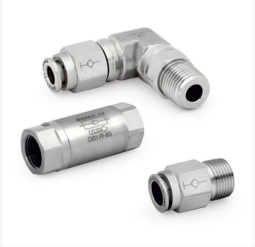
The machine is still running. Nothing has jammed, no alarm has gone off, and the operator only says it feels a bit lazy. A cylinder takes a fraction of a second longer to return, a gripper hesitates, and the line loses a few parts every hour. Faults like this rarely show up on a maintenance report, but the cause usually sits in the pneumatic valve fittings between the control valve and the actuator.
So where does the time go? Air has to enter a cylinder quickly and leave just as quickly. Every restriction on that path adds a small delay, and those delays add up over a shift. The right pneumatic valve fittings in the right places can win back much of that lost speed without replacing the machine itself.
Why a Pneumatic Cylinder Slows Down Before Anything Breaks
Start with supply pressure, since it is the easiest thing to check. Guidance from the U.S. Department of Energy and the Compressed Air Challenge says leaks lower system pressure, which makes air tools and equipment work less effectively. A cylinder fed by a leaky line moves with less force and more slowly.
Exhaust is the second suspect, and probably the one people check least. When a cylinder retracts, the air on the other side has to escape. If that air has to travel back through a long hose and out through the control valve, the stroke drags.
Then there are the small parts. An undersized coupling, a check valve with a worn seat, or a flow regulator someone closed too far during a past repair can each take the edge off a machine’s response.
Quick Exhaust Valves: The Pneumatic Fitting That Shortens Return Strokes
A quick exhaust valve sits directly on the cylinder port, after the control valve. When the stroke reverses, it dumps the exhaust air through its own port instead of sending it all the way back down the line.
That shorter path is the whole point. The rod moves faster and the cycle time drops. You can fit one at the rod end, the blind end, or both, depending on which stroke needs the help.
Sealexcel’s stainless steel quick exhaust valves come in 1/8-inch to 1-inch pipe thread sizes. They are rated up to 10 bar (145 psi) and 120°C (248°F), with Viton seals and BSP, BSPT, or NPT end connections.
A word of caution here. Faster is not always better. A cylinder that slams into its end stop can damage tooling or shake fixtures loose, so speed needs control.
Flow Control Regulators for Repeatable Cylinder Speed
This is where flow control regulators come in. They set how quickly air enters or leaves a cylinder, which in turn sets how fast the rod moves.
Used well, they make a machine feel more predictable, not just faster. Each cycle lands at the same pace, and operators stop adjusting things by feel.
Sealexcel makes standard stainless steel flow control regulators rated up to 10 bar (145 psi) and 120°C (248°F), in 1/8-inch to 1/2-inch pipe thread sizes. It also makes bar stock body versions. The one-way adjustment model handles up to 16 bar (232 psi), and the bi-directional model goes up to 40 bar (580 psi).
These units suit chemical, food, pharmaceutical, and packaging lines, where stainless steel holds up better in wet or aggressive conditions.
Check Valves, Couplings and Push-In Fittings That Quietly Restrict Flow
Not every slowdown comes from the obvious valves. Some of it hides in parts nobody thinks about.
- A pneumatic check valve with debris on its seat can let air creep back and soften a held position.
- A quick connect coupling with a worn seal can leak only under load, so it looks fine at rest.
- A push-in fitting with a poorly seated tube can drop pressure right at the cylinder.
- A needle valve or ball valve left partly closed after maintenance can choke an entire branch.
None of these failures is dramatic. That is perhaps why they last so long.
Choosing Stainless Steel Pneumatic Valve Fittings for Demanding Lines
Brass and plated parts work fine in plenty of dry, clean plants. Washdown areas, chemical handling, and food lines are different because corrosion inside a valve affects sealing and movement.
Before you reorder, ask yourself a few questions. What pressure does the circuit actually run at? Which thread type does the cylinder port use? Does the machine need more speed, steadier speed, or both?
Your answers matter more than any catalog number. They also tell you whether one fitting will fix the problem or whether the whole air path needs a second look.
Sealexcel manufactures stainless steel quick exhaust valves, flow control regulators, pneumatic check valves, quick-connect couplings, push-in fittings, needle valves, and ball valves for industrial air systems.