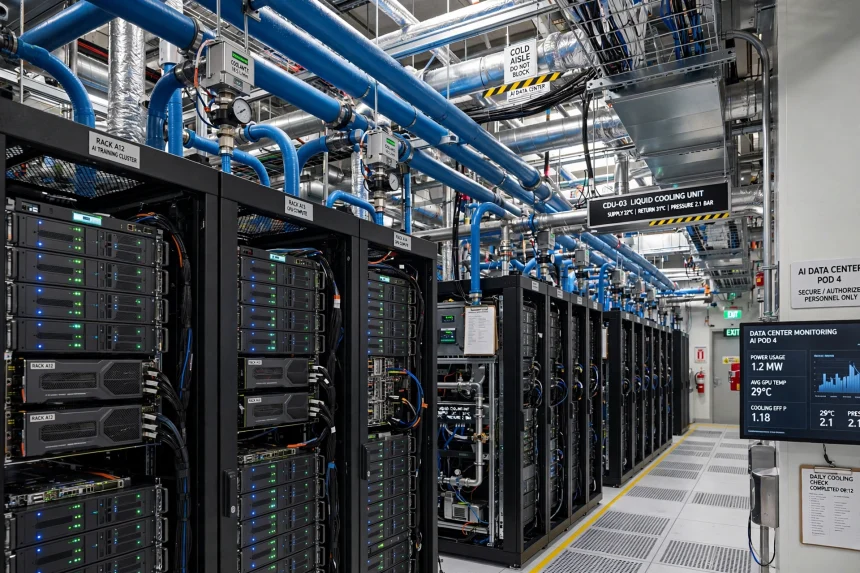
The race to build artificial intelligence infrastructure has become one of the largest capital spending stories in modern business. Cloud providers, chipmakers and private investors are committing hundreds of billions of dollars to data centers, power contracts and specialised hardware. Yet a growing number of analysts are asking a simple question: is the revenue arriving fast enough to pay for it all?
That question sharpened this week as new reporting suggested infrastructure spending forecasts continue to outstrip expected AI revenue. The concern, covered in detail by The Register, is not that AI lacks demand. Demand is real and rising. The concern is timing, scale and who ultimately carries the risk when construction runs years ahead of cash flow.
A Build-Out Measured in Hundreds of Billions
Modern AI models require enormous computing power to train and run. Each new generation of data center needs advanced chips, high-capacity networking, liquid cooling and, above all, electricity. Utilities in several regions are fielding connection requests that rival the load of small cities, while developers compete for land near transmission lines and fibre routes.
The International Energy Agency has documented how quickly this demand is growing in its research on energy and AI, noting that data centers are becoming a material factor in power planning. For investors, that creates opportunity in everything from turbines to transformers. For communities, it raises practical questions about grid capacity, water use and whether promised jobs match the scale of the subsidies on offer.
Why the Revenue Gap Matters
Capital spending is not a problem by itself. Railways, broadband networks and cloud computing all required heavy investment before returns matured. The risk appears when spending plans assume rapid adoption at premium prices, while customers are still testing where AI actually saves money or creates new products.
Many companies are still in an experimental phase. They are paying for copilots, chat tools and automation pilots, and measuring whether those tools improve output enough to justify renewal at scale. That measured approach is sensible for buyers, but it can leave infrastructure owners exposed if utilisation falls short. Businesses watching costs closely, as seen in how retailers are balancing holiday hiring with firm consumer spending, are unlikely to sign open-ended AI contracts without clear returns.
Three Groups Carrying the Risk
First are the technology giants themselves. Their balance sheets can absorb large projects, but shareholders will eventually demand evidence that AI services produce durable margins, not just impressive demonstrations. Depreciation on fast-obsolescing hardware is a real cost, and chips bought today may be superseded within a few product cycles.
Second are the newer infrastructure firms and special-purpose vehicles raising debt against future data center leases. If a single anchor tenant delays, downsizes or renegotiates, the financing maths can change quickly. Lenders are therefore scrutinising contract length, tenant credit quality and power availability more closely than they did during the first wave of announcements.
Third are utilities and ratepayers. Building generation and transmission for a data center that arrives late, or never reaches full load, can shift costs onto other customers unless regulators structure agreements carefully. Several jurisdictions are now requiring large users to commit to minimum payments, precisely to avoid that outcome.
What Smart Businesses Should Watch
For companies that buy AI services rather than build them, the spending race is mostly good news. Competition among providers should keep prices falling and features improving. The practical advice is to negotiate flexibility: shorter commitments, clear exit terms and pricing tied to actual usage rather than optimistic forecasts.
Founders and finance teams should also treat AI spending like any other major investment, with a measurable business case. As we noted in our look at why CPAs are a key resource for startups seeking funding, disciplined forecasting separates credible growth plans from hype, and investors fund the former.
The Bottom Line
The AI build-out is not about to stop. The technology is too useful, and the strategic stakes between major firms and nations are too high. But the next phase will be judged less on announcements and more on arithmetic: utilisation rates, revenue per data center and the cost of capital. Companies that can show those numbers working will keep building. Those that cannot may discover that in infrastructure, as in every previous boom, the bill always arrives before the celebration ends.