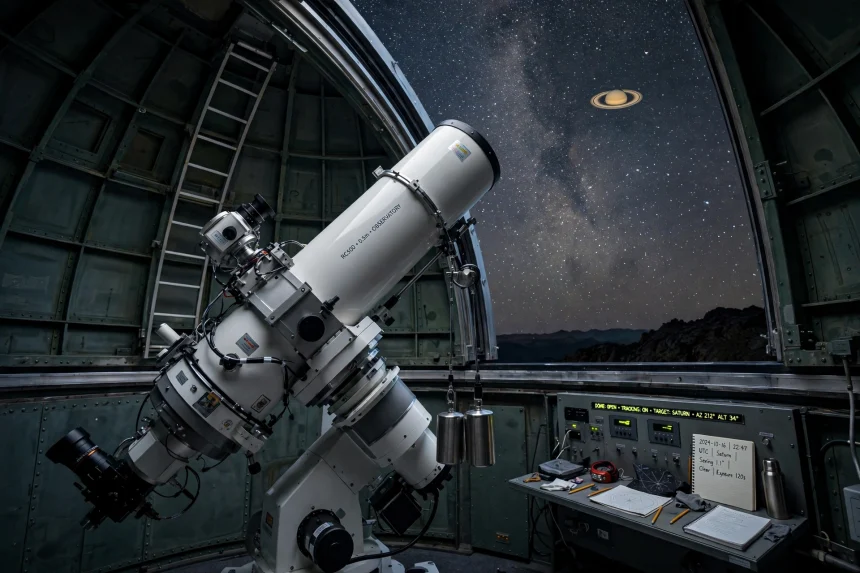
Saturn has extended a lead that is beginning to look unassailable. Astronomers have confirmed 128 new moons of the ringed planet, lifting its total to 274 — the largest number of natural satellites known for any planet, and a reminder that even our own solar system remains only partly catalogued.
The additions are irregular moons, small bodies a few kilometres wide on distant, tilted orbits. None will trouble Titan, Saturn’s giant, haze-shrouded moon, for attention. Collectively, though, they transform the statistics of the Saturn system and give researchers a far larger sample of captured and shattered objects to study.
A survey measured in years, not nights
The moons were identified in data from the Canada-France-Hawaii Telescope, using a shift-and-stack method that combines many exposures so that objects moving with Saturn become visible against the stars. Researchers at the University of British Columbia led the work of confirming candidates and refining their orbits.
Confirmation is a formal business. The International Astronomical Union recognises a moon only when observations pin down its orbit securely, which is why announcements arrive in batches long after the first images were taken. The process resembles an audit: claims are checked, numbers verified, and only then entered into the ledger.
Why investors in space should care about moon counts
Catalogues of small bodies are not merely academic. Every mapped object refines models of the environment spacecraft must navigate, and the same survey techniques that find two-kilometre moons also find asteroids of commercial and planetary-defence interest. The skills pipeline matters too: the analysts who process survey data are the same specialists sought by the growing space sector.
There is also a contrast worth noting with the economics of the AI data centre build-out. Where that industry expands by pouring capital into new facilities, astronomy’s latest headline was produced largely by patience, software and an existing telescope — output rising while the physical footprint barely changed.
Collision families rewrite Saturn’s past
Scientifically, the prize is the family structure of the irregular moons. Clusters sharing similar orbits are interpreted as fragments of larger bodies destroyed by collisions. Doubling the known membership of some clusters lets researchers estimate the timing and scale of those impacts with new confidence.
Those estimates feed into the grand narrative of the solar system: how the giant planets migrated, how much debris surrounded them, and how the calm arrangement of today emerged from a more violent past.
With next-generation observatories preparing to survey the sky more deeply than ever, few astronomers expect 274 to be Saturn’s final number. The count will rise again; the only question is by how much, and what the new arrivals reveal when they do.
The economics of a deeper catalogue
There is a balance-sheet angle to the Saturn census that rarely makes the headlines. Surveys of this kind are inexpensive by the standards of space science: the telescope already exists, the observing time is allocated competitively, and the principal investment is the salaries of the astronomers and the computing that turns raw images into orbits. Against that modest cost sits an outsized return — a permanent addition to humanity’s map of its own planetary neighbourhood, available to every researcher and mission planner thereafter.
The catalogue also appreciates in value as activity in deep space grows. Commercial and agency missions increasingly target the outer planets and the small-body populations among them, and every characterised object reduces uncertainty for the engineers who must thread spacecraft through those regions. Insurers, too, take an interest in debris and small-body environments when they price ambitious missions.
Finally, the census is a reminder that discovery has not finished migrating from hardware to software. The photons that revealed these moons fell on detectors in the ordinary course of a survey; the breakthrough lay in stacking, subtraction and orbit-fitting — in treating the sky as a dataset. As archives grow and algorithms improve, some fraction of tomorrow’s moons is, in all probability, already sitting in yesterday’s data, waiting to be recognised.