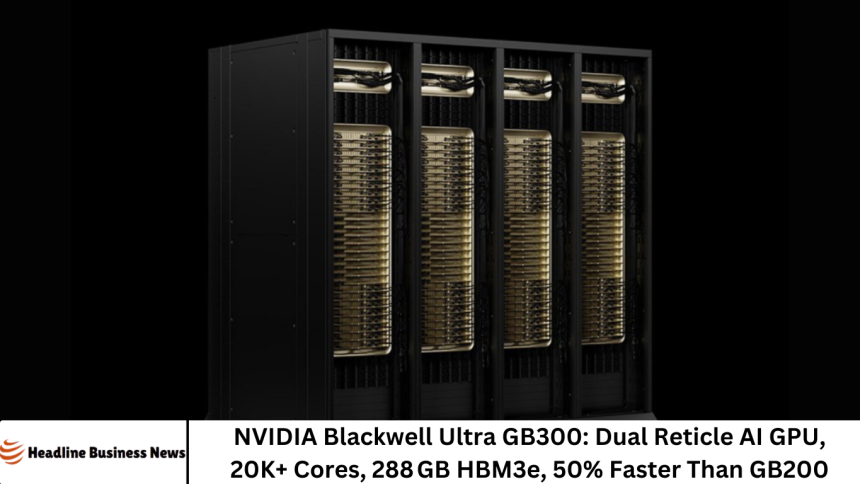
NVIDIA has once again pushed the boundaries of AI computing with its latest flagship GPU, the Blackwell Ultra GB300. Designed for extreme AI workloads, high-performance computing (HPC), and large-scale data processing, this GPU is already being hailed as a game-changer for researchers, enterprises, and developers.
In this article, we dive deep into its specifications, architecture, performance benchmarks, and implications for the future of artificial intelligence and machine learning.
More Read: Venezuela Stations Troops at Colombia Border as U.S. Ships Join Anti-Cartel Effort
Overview of the NVIDIA Blackwell Ultra GB300
The NVIDIA Blackwell Ultra GB300 is the successor to the GB200, promising up to 50% faster performance while incorporating cutting-edge technologies that elevate AI processing to new heights. With a dual reticle design, over 20,000 CUDA and Tensor cores, and 288 GB of HBM3e memory, the GB300 is designed for workloads that demand maximum throughput and efficiency.
Key Highlights:
- Dual Reticle GPU Architecture
- 20,480+ CUDA & Tensor Cores
- 288 GB HBM3e Memory
- Memory Bandwidth: 8 TB/s
- 50% Performance Increase Over GB200
- Optimized for AI, ML, and HPC
Dual Reticle Architecture: A Leap in GPU Design
One of the standout features of the GB300 is its dual reticle architecture. Traditional GPUs rely on a single reticle design, which limits the number of cores and memory channels per chip. By integrating two reticles on a single GPU package, NVIDIA has effectively doubled the computational density while maintaining efficient power and thermal management.
This design allows the GB300 to:
- Support larger AI models with billions of parameters
- Process multiple AI workloads in parallel
- Achieve higher memory bandwidth with minimal latency
The dual reticle setup ensures that data flows seamlessly between cores and memory, reducing bottlenecks that often plague large-scale AI training tasks.
Massive Core Count: 20,000+ Cores for Extreme AI
The GB300 boasts over 20,000 CUDA and Tensor cores, a significant increase from the GB200. These cores are designed to handle parallel processing at unprecedented scale, making the GB300 ideal for tasks like:
- Deep learning model training
- Large-scale inference
- Simulation and rendering
- Scientific computing
The increase in core count directly translates to faster model training times and higher throughput for complex AI workloads. For AI researchers, this means training larger models faster and experimenting with more sophisticated architectures without being constrained by GPU limitations.
288 GB HBM3e Memory: Redefining GPU Bandwidth
Memory is critical for AI workloads, and the GB300 delivers 288 GB of HBM3e memory with a staggering 8 TB/s bandwidth. High Bandwidth Memory (HBM3e) ensures that AI models can access large datasets quickly without being bottlenecked by memory transfer speeds.
Benefits of HBM3e include:
- Reduced data transfer latency between cores and memory
- Efficient handling of massive datasets for training AI models
- Enhanced performance for tasks like natural language processing (NLP) and computer vision
With 288 GB of VRAM, the GB300 allows AI models to train on entire datasets in memory, minimizing the need for slower off-chip storage solutions.
Performance: 50% Faster Than GB200
The GB300 achieves up to 50% faster performance compared to the GB200, thanks to its combination of dual reticle architecture, massive core count, and HBM3e memory. Early benchmarks and tests indicate:
- 1.5x faster AI model training on large transformer networks
- Up to 2x improvement in mixed-precision computations
- Enhanced throughput for GPU-accelerated HPC simulations
This performance gain is a game-changer for AI researchers, reducing training times from weeks to days for large-scale models.
AI and Deep Learning Applications
The NVIDIA Blackwell Ultra GB300 is designed for AI workloads of all scales. Its high core count and memory bandwidth make it suitable for:
1. Large Language Models (LLMs)
Training state-of-the-art LLMs requires immense GPU resources. With the GB300, developers can train models with billions to trillions of parameters efficiently, opening doors for more advanced AI assistants and NLP systems.
2. Computer Vision
Tasks such as image classification, object detection, and video processing benefit from the GB300’s parallel processing power. Researchers can experiment with larger datasets and more complex models without sacrificing performance.
3. Scientific Computing & HPC
The GPU’s high throughput makes it ideal for simulations, molecular modeling, and climate modeling. Dual reticle architecture ensures that these workloads execute efficiently even at scale.
4. Real-Time Inference
For AI applications in autonomous vehicles, robotics, or recommendation engines, the GB300 provides low-latency inference while handling massive amounts of data in real-time.
Comparisons with GB200
The GB200 was a highly capable GPU, but the GB300 takes performance to the next level. Here’s a side-by-side comparison:
| Feature | GB200 | GB300 | Improvement |
|---|---|---|---|
| Cores | 13,000+ | 20,480+ | ~57% more cores |
| Memory | 192 GB HBM3 | 288 GB HBM3e | 50% more memory |
| Memory Bandwidth | 5.5 TB/s | 8 TB/s | ~45% faster |
| AI Performance | High | Ultra | 50% faster overall |
| Architecture | Single Reticle | Dual Reticle | Better efficiency & scaling |
The GB300 clearly outperforms the GB200 in every key metric, making it the ultimate choice for next-generation AI applications.
Energy Efficiency and Thermal Management
Despite the massive increase in performance, NVIDIA has prioritized energy efficiency with the GB300. Advanced power management features and the dual reticle design ensure that:
- Energy consumption is optimized for large-scale AI workloads
- Heat generation is efficiently managed through advanced cooling solutions
- Sustained high-performance operations are possible without throttling
This makes the GB300 not only powerful but also practical for data centers where energy efficiency is critical.
Impact on AI Research and Industry
The introduction of the GB300 has significant implications for both AI research and industry adoption:
- Accelerated Model Development: Researchers can iterate faster and experiment with more complex architectures.
- Enterprise AI: Businesses can deploy larger AI models for predictive analytics, automation, and recommendation systems.
- Scientific Breakthroughs: Faster simulations mean quicker insights in fields like genomics, climate science, and physics.
- Democratization of AI: High-performance GPUs like the GB300 make cutting-edge AI accessible to more developers and organizations.
Availability and Pricing
While NVIDIA has announced the GB300, the exact release date and pricing may vary depending on the region and market demand. Given its advanced features and performance, it is expected to be positioned as a premium GPU for AI and HPC applications.
Organizations investing in AI infrastructure should consider the GB300 for:
- AI model training clusters
- High-performance data centers
- GPU farms for scientific research
Frequently Asked Question
What is the NVIDIA Blackwell Ultra GB300?
The NVIDIA Blackwell Ultra GB300 is a next-generation AI GPU designed for high-performance computing, deep learning, and large-scale AI workloads. It features a dual reticle architecture, over 20,000 CUDA and Tensor cores, and 288 GB of HBM3e memory with 8 TB/s bandwidth, making it significantly faster than its predecessor, the GB200.
How does the dual reticle architecture improve performance?
The dual reticle design effectively combines two GPU reticles into a single package. This allows more cores, higher memory bandwidth, and better parallel processing efficiency. It reduces data transfer bottlenecks, enabling faster AI training, real-time inference, and improved performance for large datasets.
How many cores does the GB300 have, and why does it matter?
The GB300 has over 20,000 CUDA and Tensor cores. A higher core count allows the GPU to process massive parallel computations, which is crucial for AI model training, simulation, and scientific computing. More cores mean faster processing times and higher throughput for demanding workloads.
What type of memory does the GB300 use, and what are its benefits?
It uses 288 GB of HBM3e memory with 8 TB/s bandwidth. HBM3e provides ultra-fast data access between cores and memory, reduces latency, and allows large AI models and datasets to be stored directly in GPU memory. This is ideal for deep learning, large language models, and high-resolution simulations.
How much faster is the GB300 compared to the GB200?
The GB300 is designed to be up to 50% faster than the GB200. Improvements come from the dual reticle architecture, higher core count, and faster memory. Users can expect reduced AI training times, higher inference throughput, and better performance for complex simulations.
What types of applications is the GB300 best suited for?
The GB300 excels in:
- AI and Machine Learning: Training and inference for large models
- Computer Vision: Image recognition, object detection, and video analysis
- Scientific Computing: Simulations in physics, climate modeling, and genomics
- High-Performance Data Centers: Large-scale AI workloads and GPU clusters
When will the NVIDIA Blackwell Ultra GB300 be available, and what is the expected price?
Exact release dates and pricing are not fully disclosed, but the GB300 is expected to launch as a premium AI GPU for enterprises, research labs, and high-performance computing centers. Organizations investing in AI infrastructure will likely be the first to adopt it due to its advanced capabilities and high-performance metrics.
Conclusion
The NVIDIA Blackwell Ultra GB300 represents a massive leap forward in GPU technology. With dual reticle architecture, over 20,000 cores, 288 GB of HBM3e memory, and 50% faster performance than the GB200, it is designed for next-generation AI, HPC, and deep learning applications. For AI researchers, developers, and enterprises looking to push the limits of what is possible, the GB300 offers unmatched performance, efficiency, and scalability. As AI continues to advance, GPUs like the GB300 will be at the heart of innovation, enabling breakthroughs that were once considered impossible.