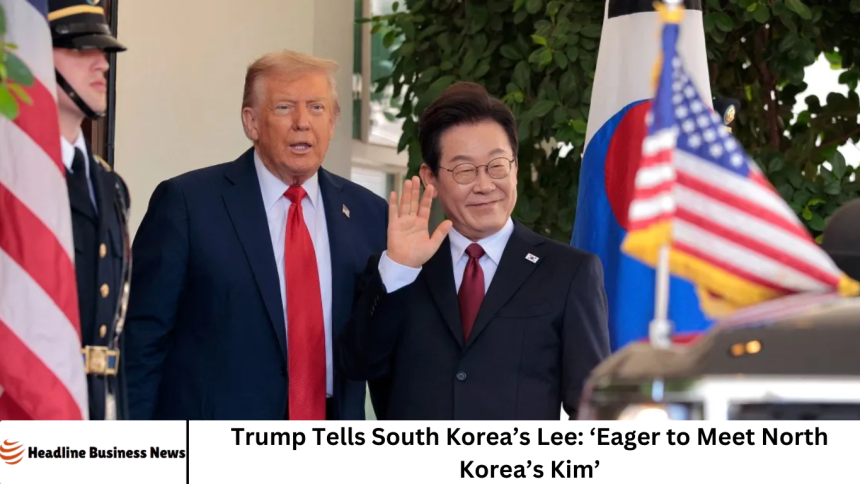
WASHINGTON, D.C. — In a significant diplomatic development that could reshape regional dynamics in East Asia, U.S. President Donald Trump expressed his strong interest in meeting North Korean leader Kim Jong Un once again.
This came during a high-level summit with South Korean President Lee Jae-myung, who made his first official visit to the White House since taking office. The meeting between the two leaders signals a potential revival of trilateral diplomacy aimed at easing tensions on the Korean Peninsula.
As the global community watches closely, both Washington and Seoul are indicating a willingness to re-engage Pyongyang in dialogue — a move that could lead to a new chapter in inter-Korean and U.S.-North Korea relations.
More Read: Water-Soluble 3D-Printed Electronics Enable Easy Recycling
The Meeting at the White House
During a joint press appearance after their closed-door discussions, President Trump praised President Lee’s vision for peace and acknowledged the importance of South Korea’s leadership role in the region.
“President Lee is committed to healing the wounds of the past, and I admire that,” Trump said. “And I told him today — I’m eager to meet Chairman Kim again if it means a better future for the Korean Peninsula.”
The two leaders discussed a broad range of issues, including regional security, economic cooperation, and military readiness. However, the North Korea issue dominated the conversation, reflecting its critical importance to both nations.
President Lee, in turn, reaffirmed Seoul’s readiness to support diplomatic engagement with Pyongyang. “We believe that dialogue is the only way forward,” he said. “Chairman Kim will be waiting, and South Korea will do its part to bring both sides to the table.”
Trump’s Renewed Interest in Kim Jong Un
Donald Trump made history in 2018 by becoming the first sitting U.S. president to meet with a North Korean leader. His unprecedented summits with Kim Jong Un in Singapore and Hanoi captured global headlines, though they ultimately failed to produce a lasting agreement.
Despite these setbacks, Trump has consistently emphasized his personal rapport with Kim, referring to their relationship as “very good” and expressing hope for future meetings. His recent comments suggest that Trump views renewed diplomacy as not only possible, but desirable.
This renewed eagerness could be part of a broader strategic calculation — both for domestic political gains and for securing a legacy of international peacemaking.
President Lee’s Approach to North Korea
President Lee Jae-myung, elected earlier this year, has taken a markedly different tone from some of his predecessors. A former human rights lawyer and strong advocate for social justice, Lee has pledged to pursue a “peace-first” strategy with North Korea.
Unlike previous conservative administrations in Seoul, which prioritized sanctions and deterrence, Lee’s government has signaled its readiness to reopen inter-Korean communication channels and resume humanitarian aid.
In his address at the White House, Lee emphasized that “the Korean War never officially ended” and that his administration seeks a permanent peace treaty with the North. He also urged the United States to consider phased sanctions relief in exchange for verifiable steps toward denuclearization.
Historical Context: U.S.-North Korea Relations
Since the Korean War armistice in 1953, the U.S. and North Korea have maintained a tense and often hostile relationship. Various attempts at diplomacy — from the 1994 Agreed Framework to the Six-Party Talks of the 2000s — have collapsed due to mistrust, verification issues, and domestic political changes.
Trump’s initial outreach in 2018 marked a break from decades of antagonism. However, the failure of the 2019 Hanoi summit, largely over disagreements about sanctions relief and denuclearization sequencing, led to a stalemate that has persisted until now.
President Lee’s administration presents a potential opportunity to revive talks, particularly with Trump signaling his willingness to re-engage.
The Role of South Korea in the Diplomatic Equation
South Korea plays a critical intermediary role in any potential U.S.-North Korea negotiation. As a direct neighbor with the most at stake, Seoul’s policies can either facilitate or hinder diplomatic progress.
President Lee’s outreach and emphasis on trust-building are seen as key components in any successful engagement strategy. Analysts believe that his administration could help bridge the gap between Washington’s demands for full denuclearization and Pyongyang’s desire for phased incentives.
Moreover, South Korea’s economic strength and technological capabilities could be used as leverage in offering North Korea development assistance, infrastructure investment, and humanitarian aid.
Global Reactions and Strategic Implications
The news of Trump’s openness to meeting Kim Jong Un again has sparked a wave of international responses.
- China, a major stakeholder in the region, welcomed the possibility of renewed dialogue, urging all parties to avoid provocations and focus on diplomacy.
- Japan expressed cautious optimism but reiterated its concerns about missile tests and the need for North Korea to address past abduction cases.
- Russia endorsed the move as a chance to de-escalate tensions and called for the lifting of certain sanctions as a goodwill gesture.
Global markets also reacted, with South Korean stocks and the Korean won seeing modest gains amid hopes for improved regional stability.
Prospects for Denuclearization Talks
The question on everyone’s mind is whether a new Trump-Kim summit could actually produce results. Experts are divided.
On one hand, Trump’s personal diplomacy has the potential to break the deadlock that traditional channels have failed to overcome. His unconventional style and willingness to negotiate directly with autocratic leaders could, once again, open doors.
On the other hand, critics argue that without a clearly defined framework and commitment to verifiable steps, another summit could be little more than a photo-op. For denuclearization to proceed meaningfully, a phased, multilateral, and legally binding process would be necessary.
President Lee has proposed a “step-by-step” roadmap that includes:
- A freeze on nuclear testing in exchange for limited sanctions relief
- The reopening of Kaesong Industrial Complex
- An official end-of-war declaration
- The gradual dismantling of North Korea’s nuclear facilities with international verification
Challenges Facing a New Trump-Kim Summit
Despite the optimism, there are several key challenges that could derail efforts to organize a new summit:
- North Korea’s Conditions: Pyongyang has demanded the lifting of key sanctions as a precondition for talks, which Washington has been unwilling to do without concrete steps on denuclearization.
- U.S. Domestic Politics: With a contentious election season approaching, Trump may face criticism for engaging with a regime accused of widespread human rights abuses.
- Military Tensions: Recent missile tests by North Korea and joint military exercises between the U.S. and South Korea continue to strain the atmosphere for dialogue.
- International Sanctions: Existing UN sanctions complicate the negotiation landscape, limiting what can be offered without consensus among Security Council members.
Still, both Trump and Lee appear committed to at least exploring the possibility of talks — a stance that has rekindled hope among peace advocates.
Frequently Asked Question
What did President Trump say about meeting Kim Jong Un?
President Donald Trump stated that he is “eager to meet” North Korean leader Kim Jong Un during a joint meeting with South Korean President Lee Jae-myung at the White House. This signals his renewed interest in reviving diplomatic efforts with North Korea.
Who is South Korean President Lee Jae-myung, and what is his stance on North Korea?
Lee Jae-myung is South Korea’s newly elected president and a progressive leader known for advocating peace and reconciliation with North Korea. He supports diplomatic engagement, humanitarian aid, and a long-term roadmap for denuclearization and peace on the Korean Peninsula.
Why is a Trump-Kim meeting significant?
A potential meeting between Donald Trump and Kim Jong Un would be significant because it could revive stalled nuclear negotiations and ease tensions in East Asia. Previous Trump-Kim summits made history but failed to deliver a lasting agreement. A new meeting could reset the process.
Has Trump met Kim Jong Un before?
Yes. Trump met Kim Jong Un three times during his presidency — in Singapore (2018), Hanoi (2019), and briefly at the DMZ (2019). While these meetings marked a diplomatic breakthrough, they did not result in a formal denuclearization agreement.
What role is South Korea playing in facilitating U.S.-North Korea talks?
South Korea, under President Lee, is acting as a diplomatic bridge between Washington and Pyongyang. Lee’s administration is encouraging dialogue and proposing phased steps to build trust and move toward peace and denuclearization on the Korean Peninsula.
What are the challenges to a new Trump-Kim summit?
Key challenges include:
- North Korea’s demand for sanctions relief
- U.S. insistence on verifiable denuclearization steps
- Military tensions and missile tests
- Lack of trust between parties
- Complex regional dynamics involving China and Japan
How has the international community reacted to Trump’s statement?
Reactions have been mixed. China and Russia have welcomed the possibility of dialogue, Japan remains cautious, and global markets responded positively. Many observers are hopeful but skeptical, noting that past efforts collapsed without tangible results.
Conclusion
The statement “Trump Tells South Korea’s Lee: ‘Eager to Meet North Korea’s Kim’” may come to define a turning point in the stalled diplomatic process with Pyongyang. With a newly elected South Korean president eager to mend ties and a U.S. president who has already rewritten the playbook on North Korea, the conditions may be ripe for a new chapter of engagement. Whether this results in a formal summit, a series of working-level talks, or simply a symbolic gesture, remains to be seen. What is clear, however, is that both Seoul and Washington recognize the value of dialogue — and the cost of returning to isolation and confrontation.