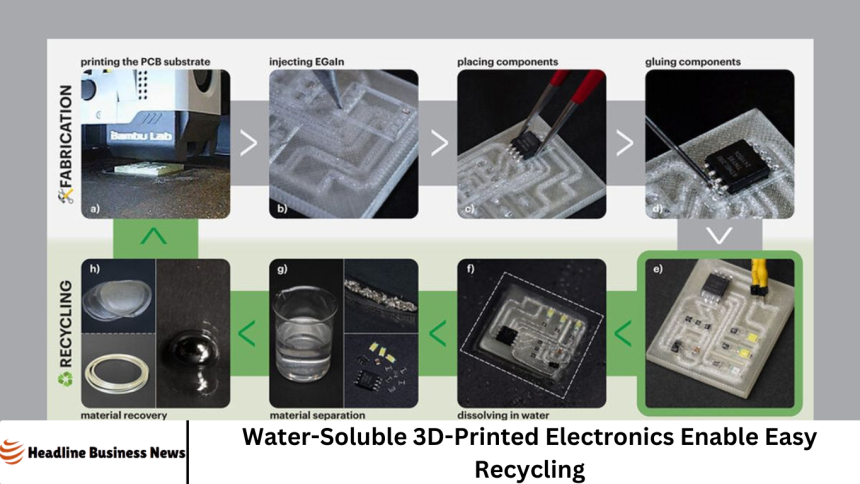
In today’s fast-paced digital world, the demand for electronic devices is soaring. But with this surge comes a mounting challenge: electronic waste, or e-waste. According to the Global E-Waste Monitor, the world generated over 57 million metric tons of e-waste in 2021—and that number continues to grow.
Much of this waste ends up in landfills, leaching harmful chemicals into the environment. But a new development may offer a game-changing solution: water-soluble 3D-printed electronics.
Imagine Bluetooth speakers, sensors, or smart packaging made from materials that dissolve in water within hours, leaving no toxic residue behind. This innovation not only allows for quick and easy recycling but also has the potential to redefine how we design, use, and dispose of electronics.
More Read: Visualizing Sound: Transforming Music into Logos and Imagery
What Are Water-Soluble 3D-Printed Electronics?
Water-soluble 3D-printed electronics are devices fabricated using dissolvable materials via additive manufacturing (3D printing). These materials are engineered to disintegrate in water, making the devices fully or partially biodegradable.
The key components include:
- Water-soluble substrates (like PVA – polyvinyl alcohol)
- Biodegradable conductive inks (often infused with silver or carbon-based particles)
- Eco-friendly encapsulants that protect components until exposure to water
This combination allows designers to create functioning electronic devices—including circuits, sensors, batteries, and casings—that can be completely recycled or biodegraded by simply rinsing them in water.
Why This Innovation Matters
1. Addressing the E-Waste Crisis
Traditional electronics are notoriously difficult to recycle due to their complex compositions—a single smartphone can contain over 60 elements, including rare earth metals, plastics, and toxic chemicals.
Water-soluble electronics offer an elegant solution by simplifying the disassembly and recovery process. Components can be separated without mechanical or chemical intervention, significantly reducing processing costs and environmental hazards.
2. Faster Prototyping for Electronics
Because of their low cost and ease of disposal, water-soluble electronics are perfect for rapid prototyping. Designers and engineers can iterate quickly without worrying about waste. This accelerates innovation while maintaining environmental responsibility.
3. Reducing Plastic Use
Many electronic devices use non-biodegradable plastics in their casings and insulation. With 3D printing using biopolymers and water-soluble materials, the need for traditional plastics is dramatically reduced.
4. Enabling Single-Use Smart Devices
In some applications, electronics are designed for short-term use—like medical patches, smart packaging, or environmental sensors. Making these devices water-dissolvable ensures they don’t linger in landfills for decades after a few days of use.
How the Technology Works
The Role of Additive Manufacturing
3D printing enables the layer-by-layer construction of complex geometries and integrated electronics without needing molds or mass-production tools. This makes it ideal for:
- Embedding conductive pathways
- Printing flexible circuits
- Integrating sensors directly into biodegradable structures
Materials Used
- Polyvinyl Alcohol (PVA): A water-soluble, biodegradable polymer often used as the main structural material.
- Carbohydrate-based Polymers: Derived from starch or cellulose for enhanced biodegradability.
- Conductive Inks: Silver nanoparticle or carbon nanotube-based inks allow current to flow through printed circuits.
- Gel Electrolytes: For powering small-scale batteries that can also degrade safely.
Water-Induced Disintegration
When exposed to water, materials like PVA start to dissolve. Within minutes to a few hours, depending on the material thickness and water temperature, the device breaks down. Remaining components can either be filtered for recycling or naturally biodegrade.
Applications of Water-Soluble 3D-Printed Electronics
1. Consumer Electronics
- Bluetooth speakers
- Smartphone accessories
- Temporary wearables
Devices made for short-term use or frequent upgrades can now be easily disassembled and recycled—or even dissolved at home.
2. Medical Devices
- Disposable biosensors
- Smart bandages
- Drug delivery systems
Water-soluble materials ensure that devices safely dissolve inside the body or in clinical waste systems, reducing cross-contamination risks and environmental harm.
3. Environmental Sensors
- Soil moisture monitors
- Water quality test kits
These sensors can be deployed in nature without worrying about cleanup. After collecting data, they disintegrate in rainwater or can be manually dissolved.
4. Smart Packaging
- Expiration alerts
- Temperature-sensitive packaging
Used in food and pharma industries, these electronics function for a limited time and then safely dissolve, reducing waste and contamination risks.
Challenges and Limitations
1. Material Cost and Scalability
While biodegradable materials are becoming more affordable, they are still more expensive than traditional plastics and metals. Mass adoption depends on further cost reductions and scalability.
2. Durability vs. Solubility
Balancing a device’s functional lifespan with its ability to quickly dissolve when needed is complex. Too water-sensitive, and it might fail prematurely; too resistant, and it may linger in landfills.
3. Electrical Performance
Water-soluble materials often don’t match the conductivity or efficiency of traditional metals and semiconductors, limiting their use in high-performance applications—for now.
4. Recycling Infrastructure
While the devices themselves are easier to break down, current e-waste recycling systems aren’t built to handle this new class of electronics. New disposal protocols may be needed.
The Future of Sustainable Electronics
The development of water-soluble 3D-printed electronics signals a shift toward a more circular and sustainable tech industry. Researchers are pushing the boundaries with:
- Fully compostable electronics
- Bioresorbable medical implants
- Zero-waste manufacturing processes
In time, we may see a complete overhaul of how electronics are designed, moving from linear lifecycles (production → use → disposal) to circular ones (production → use → dissolution → reuse).
Governments and tech giants are also beginning to take notice. Expect new regulations and funding for sustainable materials research, as well as eco-certifications for dissolvable devices.
Companies and Institutions Leading the Way
1. Stanford University & University of Sussex
Researchers here have published multiple studies on biodegradable conductive materials, particularly for use in printed circuit boards.
2. MIT & UC Berkeley
Both institutions are developing transient electronics—devices that disappear on command, often using environmental triggers like heat, moisture, or pH levels.
3. Private Startups
Companies such as Jiva Materials and Cohere are prototyping commercial products that use eco-friendly and water-soluble PCBs, targeting consumer tech and packaging.
SEO Tips for Brands Entering This Space
If you’re marketing a product or service in biodegradable or water-soluble electronics, consider the following SEO keywords and strategies:
Primary SEO Keywords:
- Water-soluble electronics
- Biodegradable electronics
- Eco-friendly 3D printing
- Sustainable tech
- E-waste recycling solutions
Long-Tail Keywords:
- Water-dissolvable Bluetooth speakers
- 3D printed biodegradable circuits
- Recyclable smart packaging
- Temporary wearable electronics
- Green alternatives to plastic electronics
On-Page SEO Best Practices:
- Use the keyword in titles, meta descriptions, and headers
- Include structured data for product pages
- Optimize for mobile performance
- Include internal and external links to authoritative sustainability sources
Frequently Asked Question
What are water-soluble 3D-printed electronics?
Water-soluble 3D-printed electronics are electronic devices made using dissolvable or biodegradable materials that break down when exposed to water. These materials include water-soluble polymers (like PVA) and biodegradable conductive inks, allowing entire devices or components to disintegrate safely and easily, simplifying the recycling process.
How do these electronics help with recycling?
They eliminate the need for complex manual disassembly of electronic waste. When exposed to water, the casing and certain electronic components dissolve, making it easier to separate reusable or recyclable parts and reducing the volume of landfill waste. This streamlines e-waste processing and promotes environmentally friendly disposal.
What materials are used in water-soluble electronics?
Common materials include:
- Polyvinyl alcohol (PVA) – a biodegradable polymer that dissolves in water
- Biodegradable conductive inks – often carbon- or silver-based
- Gel-based electrolytes – used in eco-friendly batteries
- Natural polymers – like cellulose or starch blends for structural components
- These materials are engineered to retain functionality for a limited time before dissolving.
Are these electronics safe for the environment?
Yes, they are designed to be non-toxic and environmentally safe. Once dissolved, the materials either break down into harmless compounds or can be safely filtered and recycled. This makes them especially useful in applications where recovery or cleanup is difficult, such as in nature or in disposable medical devices.
What types of products can be made with this technology?
Water-soluble electronics are ideal for:
- Bluetooth speakers and small consumer devices
- Disposable medical sensors and patches
- Environmental monitoring tools
- Smart packaging
- Short-term wearable tech
- They’re best suited for products with short life cycles or temporary use.
Do water-soluble electronics perform as well as traditional devices?
Currently, they offer adequate performance for low-power, short-term applications. However, they may not match the durability or conductivity of traditional electronics used in long-term or high-performance devices. As material science advances, performance is expected to improve.
Are water-soluble electronics commercially available yet?
Some prototypes and pilot products are available, especially from research institutions and startups focused on sustainability. However, wide-scale commercialization is still in development due to challenges in scalability, cost, and durability. That said, growing interest in green electronics is accelerating adoption.
Conclusion
Water-soluble 3D-printed electronics represent a transformative step forward in sustainable product design. They offer a practical solution to the e-waste crisis, enable faster innovation, and point to a future where disposable doesn’t mean destructive. As the technology matures and gains broader support from governments, manufacturers, and consumers, we can look forward to a world where high-tech doesn’t come at the expense of the planet.