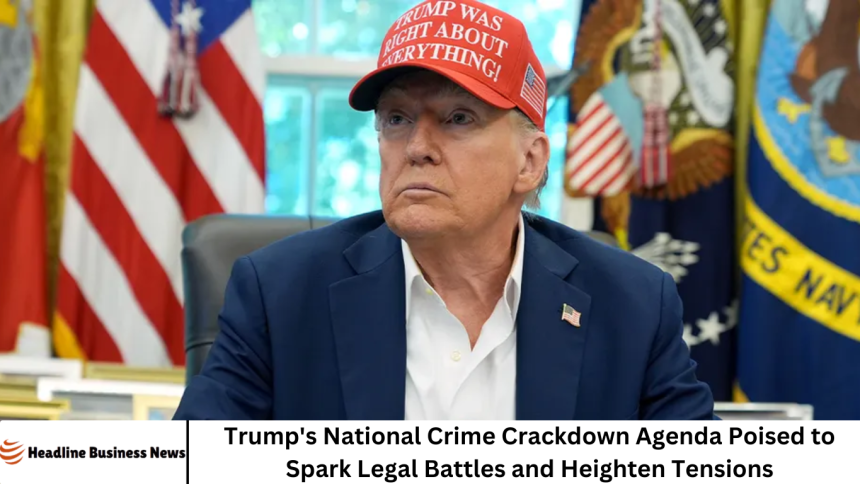
Former President Donald Trump is once again making headlines with his renewed calls for a nationwide crackdown on crime. As part of his 2024 campaign and public rhetoric, Trump has vowed to take aggressive action in major U.S. cities plagued by violent crime, particularly those led by Democratic officials. However, critics argue that his ambitious agenda is less about public safety and more about political theater, raising serious legal and constitutional questions.
With Trump signaling plans to use federal forces to “restore order” in urban centers, tensions between the federal government and states are expected to escalate. Legal experts, civil rights organizations, and local leaders warn that such actions could provoke lawsuits, protests, and a deepening of America’s political divide.
This article explores Trump’s crime crackdown strategy, the constitutional limits of presidential power, the reactions from state leaders, and the likely legal and political showdowns to come.
More Read: Cambodia Enacts Law to Revoke Citizenship for Treason Convictions
Trump’s Crime Agenda: A Familiar Playbook
Donald Trump’s tough-on-crime stance is nothing new. During his presidency, he often leaned into “law and order” messaging, portraying cities like Chicago, Baltimore, and New York as lawless zones that needed federal intervention.
In 2020, amid the racial justice protests following the murder of George Floyd, Trump deployed federal agents to Portland and Washington, D.C., without clear coordination with local authorities. These actions triggered backlash from city leaders, legal experts, and civil liberties advocates who saw the moves as authoritarian overreach.
Now, in 2024, Trump appears ready to double down. On the campaign trail, he has repeatedly stated that cities like Chicago, New York, Baltimore, and Oakland are in “crisis” and has promised to send in federal forces—possibly including the National Guard—if local officials fail to act.
“Chicago will be our next,” Trump said during a recent press event, adding that “we will help New York, Baltimore, Oakland. These cities are out of control.”
While the rhetoric may play well with his base, experts say the legal and logistical challenges of deploying federal forces across the country are far more complex than Trump suggests.
The Legal Gray Area: Can a President Send Troops to U.S. Cities?
The U.S. Constitution grants limited authority to the president when it comes to domestic law enforcement. Under the Posse Comitatus Act of 1878, federal troops are largely prohibited from engaging in local law enforcement activities unless specifically authorized by Congress or invoked under exceptions like the Insurrection Act.
Posse Comitatus Act
- Purpose: Limits the use of the U.S. military for domestic policing.
- Implication: Without a clear legal justification, Trump cannot simply deploy the military to enforce local laws in cities like Chicago or New York.
Insurrection Act
- Loophole: Allows the president to deploy troops during instances of rebellion or insurrection.
- Controversy: Trump previously considered invoking the Insurrection Act during the 2020 protests, but ultimately did not.
Legal scholars argue that invoking such laws to crack down on crime in cities—especially without consent from state governors—would likely face immediate legal challenges.
“The federal government has limited authority to intervene in state-level policing,” said constitutional law expert Laurence Tribe. “Deploying troops to cities over the objections of local officials could be seen as a violation of federalism and civil liberties.”
State and Local Resistance Is Mounting
Trump’s plan has already triggered a strong response from Democratic leaders across the country. Governors and mayors in the targeted cities have made it clear they will oppose any federal intervention that bypasses their authority.
Maryland Governor Wes Moore Responds
When Trump criticized Baltimore as a “crime-ridden disaster,” Governor Wes Moore challenged him to walk the city’s streets and see the local efforts being made. Trump declined, saying he wouldn’t visit until the city was “cleaned up.”
Moore fired back, calling Trump’s remarks “divisive and destructive.”
“We’re making real progress in reducing crime through community-based strategies,” Moore said. “We don’t need federal troops marching through our neighborhoods. We need partnership, not political stunts.”
Chicago Pushes Back
In Chicago, where Trump has often cited alarming (and sometimes misleading) crime statistics, Mayor Brandon Johnson also rejected the idea of a federal crackdown.
“This administration will not allow our communities to be used as props in a political campaign,” Johnson stated. “We welcome federal support, but it must be coordinated and respectful of our autonomy.”
Crime Rates: The Truth Behind the Numbers
While Trump paints a dire picture of American cities descending into chaos, crime data tells a more nuanced story. According to the FBI’s Uniform Crime Report, violent crime rates declined in many major cities in 2023 and early 2024.
Key Findings:
- New York City saw a 6% drop in shootings and a 12% decline in murders.
- Chicago reported fewer homicides in 2023 than in any of the previous five years.
- Baltimore began 2024 with one of its lowest quarterly crime rates in a decade.
Experts caution that while challenges remain, the narrative of “out of control” urban violence is often exaggerated for political effect.
“Crime is real, and it affects people’s lives, but nationalizing local policing decisions rarely helps,” said former DOJ official Vanita Gupta. “Community-driven solutions are far more effective.”
Potential Legal Showdowns Ahead
If Trump were to win the presidency and move forward with his crackdown plans, he would almost certainly face a wave of lawsuits and constitutional challenges.
Legal Challenges Could Include:
- Violation of State Sovereignty
- States could argue that Trump’s actions infringe on their right to govern their own law enforcement agencies.
- Unlawful Use of Military Forces
- Any deployment of National Guard troops without state consent could be challenged under the Posse Comitatus Act.
- Civil Rights Violations
- Civil liberties groups could sue on behalf of individuals subjected to federal force, citing abuses of power or excessive policing.
Who Could Sue?
- State Attorneys General
- City Governments
- Civil Rights Organizations (e.g., ACLU, NAACP)
- Private Citizens Impacted by Federal Action
Trump’s legal team would likely argue that rising crime represents a national emergency that justifies federal involvement, but courts have historically been skeptical of executive overreach in domestic policing.
The Political Gamble: Will This Strategy Work?
Trump’s law-and-order messaging has been a staple of his political identity since 2016. However, critics argue that his 2024 strategy may backfire in key battleground states.
Risks for Trump:
- Suburban Voters may be turned off by the idea of federal troops on American streets.
- Independent Voters could view the crackdown as authoritarian or extreme.
- Democratic Turnout may surge in response to perceived threats to civil liberties.
Still, among Trump’s base, the message is likely to resonate. Many voters, especially in rural and conservative areas, support strong policing and may be drawn to Trump’s promise of restoring “law and order.”
What Comes Next?
With the 2024 election heating up, Trump’s national crime crackdown agenda will remain a central theme of his campaign. Whether or not he regains office, the groundwork he’s laying now will have lasting implications for the relationship between federal and local law enforcement.
Key questions going forward include:
- Will Trump formally propose legislation to support his plan?
- How will Democratic-led cities prepare for possible federal intervention?
- Could a future Supreme Court case redefine the limits of presidential power in domestic security?
Frequently Asked Question
What is Trump’s National Crime Crackdown Agenda?
Trump’s crime crackdown agenda refers to his proposal to use federal forces—potentially including the National Guard—to intervene in U.S. cities with high crime rates, especially Democratic-led ones like Chicago, New York, and Baltimore. The plan involves bypassing local authorities if necessary, under the claim of restoring law and order.
Why is Trump’s crime crackdown plan controversial?
Critics argue that Trump’s plan infringes on state sovereignty, violates the Posse Comitatus Act (which limits military involvement in civilian law enforcement), and is based on exaggerated claims about urban crime. The plan raises concerns about constitutional overreach, potential civil rights violations, and authoritarian use of federal power.
Can a U.S. president legally deploy troops to cities without state approval?
Generally, no. The Posse Comitatus Act restricts the use of federal troops in domestic law enforcement. Exceptions include the Insurrection Act, which allows deployment during civil unrest or rebellion. However, using it to fight ordinary crime in cities is legally questionable and would likely face court challenges.
How have local and state leaders responded to Trump’s crime agenda?
Democratic governors and mayors, such as Maryland’s Wes Moore and Chicago’s Brandon Johnson, have strongly opposed Trump’s plan. They argue it undermines local governance and could lead to unnecessary militarization of communities. Many have vowed to resist any unauthorized federal intervention.
Is crime really rising in the cities Trump targets?
Crime in many major U.S. cities has declined in recent years. For example, New York and Chicago have both reported reductions in shootings and homicides since 2022. While challenges remain, experts say Trump’s rhetoric often exaggerates the problem to justify federal overreach.
What legal battles could Trump face if he pursues this plan?
If implemented, Trump’s crackdown would likely trigger lawsuits from:
- State governments
- Civil rights organizations
- Individuals affected by federal actions
- Potential legal claims include:
- Violations of state sovereignty
- Abuse of executive power
- Unlawful use of military forces
- Civil liberties infringements
Could Trump actually implement this agenda if re-elected?
If Trump wins in 2024, he could attempt to implement parts of his agenda through executive orders or emergency powers. However, Congress, the courts, and state governments would serve as key checks. Any deployment of federal forces would face intense legal scrutiny and public opposition.
Conclusion
Donald Trump’s pledge to crack down on crime in major American cities sets the stage for a potential constitutional crisis. While concerns about violence and public safety are real, the methods Trump proposes could challenge deeply held principles of federalism, civil rights, and democratic governance. As the 2024 election draws nearer, Americans must consider not only the outcomes they want on crime, but also the process by which those outcomes are pursued. The fight over Trump’s crime agenda is about more than law enforcement—it’s about the balance of power in a divided nation.