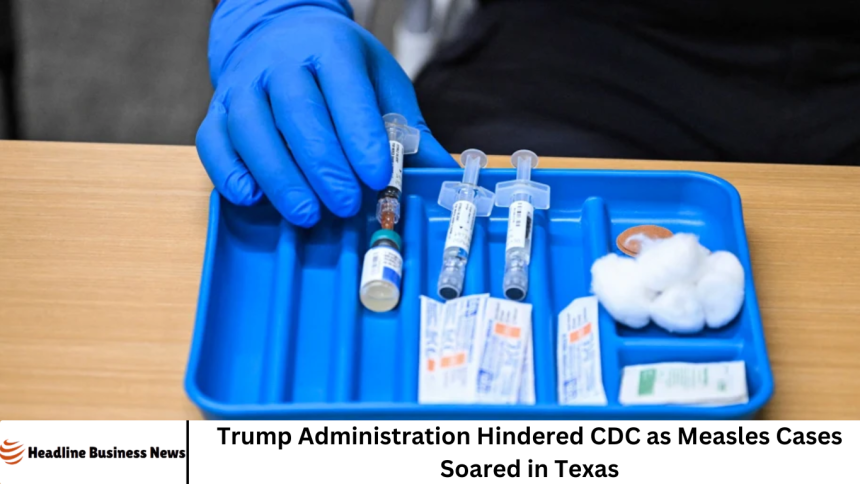
In early 2025, a comprehensive investigation by KFF Health News revealed that actions taken by the Trump administration significantly impaired the Centers for Disease Control and Prevention’s (CDC) ability to respond to a measles outbreak in Texas—one that would soon become the worst measles crisis in the United States in over 30 years.
As the preventable disease spread across communities in Texas, federal interference, communication blackouts, and a climate of fear within the CDC resulted in a fractured response. Public health officials in the hardest-hit areas reported feeling abandoned, under-informed, and isolated just when federal support was needed most.
This article explores how Trump-era policies and political interference hindered the CDC, weakened the national emergency response framework, and contributed to the escalation of a major measles outbreak.
More Read: Trump’s National Crime Crackdown Agenda Poised to Spark Legal Battles and Heighten Tensions
The Texas Measles Outbreak: A Public Health Emergency
In January 2025, hospitals in Texas began reporting a sudden surge in measles cases. The outbreak started in Lubbock and quickly spread to surrounding counties, infecting hundreds of children and adults. By early February, Texas was the epicenter of a full-blown measles epidemic, with cases multiplying at alarming rates.
Local hospitals were overwhelmed. Schools reported widespread absences. Pediatric wards filled up. What began as a handful of cases turned into a multi-county health crisis, making it the most severe measles outbreak in the U.S. since before the disease was declared eliminated in 2000.
Despite the severity, federal guidance and assistance were noticeably absent.
CDC Scientists Left in the Dark
According to interviews conducted by KFF Health News with seven current and former CDC officials, the agency’s emergency response to the outbreak was crippled not by incompetence or disinterest—but by external interference and internal silencing stemming from policies and actions introduced by the Trump administration during its final months and into the early days of its term.
“The people at the CDC knew what needed to be done,” said one senior epidemiologist who asked to remain anonymous. “But we were boxed in. We were told not to speak out, not to reach out directly. Every move required layers of approval, and most were just ignored.”
CDC employees, according to these sources, were fearful of political retaliation if they acted independently. Under the Trump administration, the CDC’s ability to communicate with local officials and the public had been severely curtailed. Emails obtained by KFF through public records requests revealed mounting frustration from local officials who felt abandoned.
Local Officials Sounded the Alarm
On February 5, just two weeks after the first hospitalizations in Lubbock, Katherine Wells, the city’s public health director, expressed her growing concerns in an email exchange with a colleague.
“CDC hasn’t reached out to us locally,” she wrote. “My staff feels like we are out here all alone.”
That sentiment was echoed by multiple local health departments across Texas, many of which had to rely on outdated CDC materials or second-hand guidance from neighboring jurisdictions. In the critical early weeks of the outbreak, the lack of coordination between federal and local health authorities contributed to missed containment opportunities.
Without federal intervention, vaccine outreach stalled. Contact tracing lagged. Public health campaigns lacked credibility and clarity. And all of this occurred as misinformation about the measles vaccine spread rapidly online.
A Pattern of Interference Under the Trump Administration
While the Texas outbreak became a glaring example of system failure, it was not an isolated event in terms of Trump administration interference with public health institutions.
Censorship and Delays
The KFF investigation found that, starting in January 2025, the Trump administration began stalling or editing CDC communications, including routine surveillance reports. Officials within the agency reported that data had to be cleared through political appointees who often altered language or suppressed findings that contradicted the administration’s narrative.
This politicization of scientific information wasn’t new. During the COVID-19 pandemic, similar patterns of censorship and manipulation were reported, including altered reports, public messaging overrides, and pressure on scientists to downplay threats.
Abrupt Layoffs and Restructuring
Compounding the issue, in late January, the administration abruptly terminated dozens of CDC staffers, many of whom had worked in emergency preparedness and infectious disease control. These cuts came without warning and disrupted teams directly responsible for coordinating outbreak responses.
One former official called the move “a strategic decapitation of the CDC’s response capabilities,” leaving the agency with fewer personnel, fractured morale, and constrained outreach just as the Texas measles outbreak was accelerating.
Vaccine Hesitancy and Political Rhetoric
The measles outbreak in Texas did not occur in a vacuum. Over the past decade, vaccine hesitancy has grown, fueled in part by online misinformation and political rhetoric that undermines trust in science.
During his campaigns and presidency, Donald Trump repeatedly courted anti-vaccine supporters and questioned vaccine safety—despite overwhelming scientific consensus on their effectiveness. His administration also rolled back funding for public health campaigns that promoted vaccination.
In Texas, a state with historically lower vaccination rates and more lenient exemption laws, this rhetoric found fertile ground. By the time the outbreak began, large pockets of unvaccinated children had become vulnerable targets for measles transmission.
Public Health Experts Raise the Alarm
Public health leaders across the country voiced concern that the CDC’s silence and inaction during the Texas crisis set a dangerous precedent.
“If the CDC can’t do its job in a national outbreak, who will?” asked Dr. Karen Mitchell, a former state epidemiologist. “This wasn’t just a breakdown in logistics. This was a deliberate dismantling of our emergency response infrastructure.”
Experts warn that every day of delay during an infectious disease outbreak compounds the crisis. Measles, one of the most contagious viruses on the planet, can infect up to 90% of unvaccinated people who are exposed to it. Quick action is essential to isolate cases, administer vaccines, and control the spread.
Yet, according to multiple insiders, CDC scientists were left with their hands tied—unable to coordinate with states, deliver guidance, or inform the public freely.
Calls for Accountability and Reform
In the wake of the KFF Health News investigation, several lawmakers and advocacy groups have called for congressional hearings to investigate political interference in the CDC’s operations. Some are demanding new legislation to safeguard public health agencies from political meddling in future emergencies.
“The integrity of the CDC must be preserved at all costs,” said Rep. Linda Chavez (D-CA), who chairs the House Subcommittee on Health. “What happened in Texas is a national disgrace, and we need to ensure it never happens again.”
There are also renewed calls to invest in rebuilding trust with communities, particularly around vaccination education and public health communication.
Where Is the CDC Now?
As of mid-2025, the CDC has begun a slow recovery process. A new director, appointed by the current administration, has pledged to restore scientific independence and transparency within the agency.
Emergency response protocols are being reviewed, and communication channels with state and local health departments are reportedly being reestablished. However, the long-term damage to public trust—and the lives affected by the Texas outbreak—remains a sobering reminder of what can happen when politics undermines public health.
Frequently Asked Question
What actions did the Trump administration take that hindered the CDC’s response?
The Trump administration interfered with the CDC’s ability to operate independently by delaying public health reports, censoring data, restricting direct communication with local health departments, and laying off key CDC staff during the early stages of the Texas measles outbreak.
How did this interference impact the measles outbreak in Texas?
The CDC’s delayed response and lack of coordination with local officials led to slower containment measures, reduced vaccination outreach, and missed opportunities to control the spread—contributing to the most severe U.S. measles outbreak in over 30 years.
Why was Texas particularly vulnerable to a measles outbreak?
Texas has one of the highest rates of vaccine exemptions in the country, particularly among school-aged children. Combined with rising vaccine hesitancy and weak public health messaging, this created ideal conditions for a widespread outbreak.
What were local health officials saying during the outbreak?
Local officials, including public health directors, expressed frustration and concern over the lack of CDC support. In emails obtained through public records, some said they felt “alone” and abandoned by federal agencies during a growing health emergency.
Did CDC scientists want to respond more strongly?
Yes. Multiple CDC officials stated they were prepared to act but were restricted by internal policies and external political pressure. Many feared professional consequences if they spoke out or took initiative without approval from political appointees.
Has there been any accountability or investigation into this?
Following the KFF Health News investigation, lawmakers and public health advocates called for congressional hearings and policy reforms to protect the CDC from political interference and ensure more effective responses to future outbreaks.
What lessons can be learned from this incident?
The outbreak highlights the dangers of politicizing public health, the need for strong federal-local communication, the importance of timely emergency response, and the critical role of vaccines and scientific transparency in preventing health crises.
Conclusion
The 2025 measles outbreak in Texas revealed deep vulnerabilities in the U.S. public health system—many of which were amplified by political interference. The Trump administration’s restrictions on the CDC severely delayed critical response efforts, leaving local health officials without the guidance or support they urgently needed. This preventable crisis underscores the importance of keeping science free from political influence, strengthening communication between federal and local agencies, and ensuring robust vaccination efforts. As future public health threats loom, the lessons from this outbreak must drive meaningful reform to restore trust and protect lives.