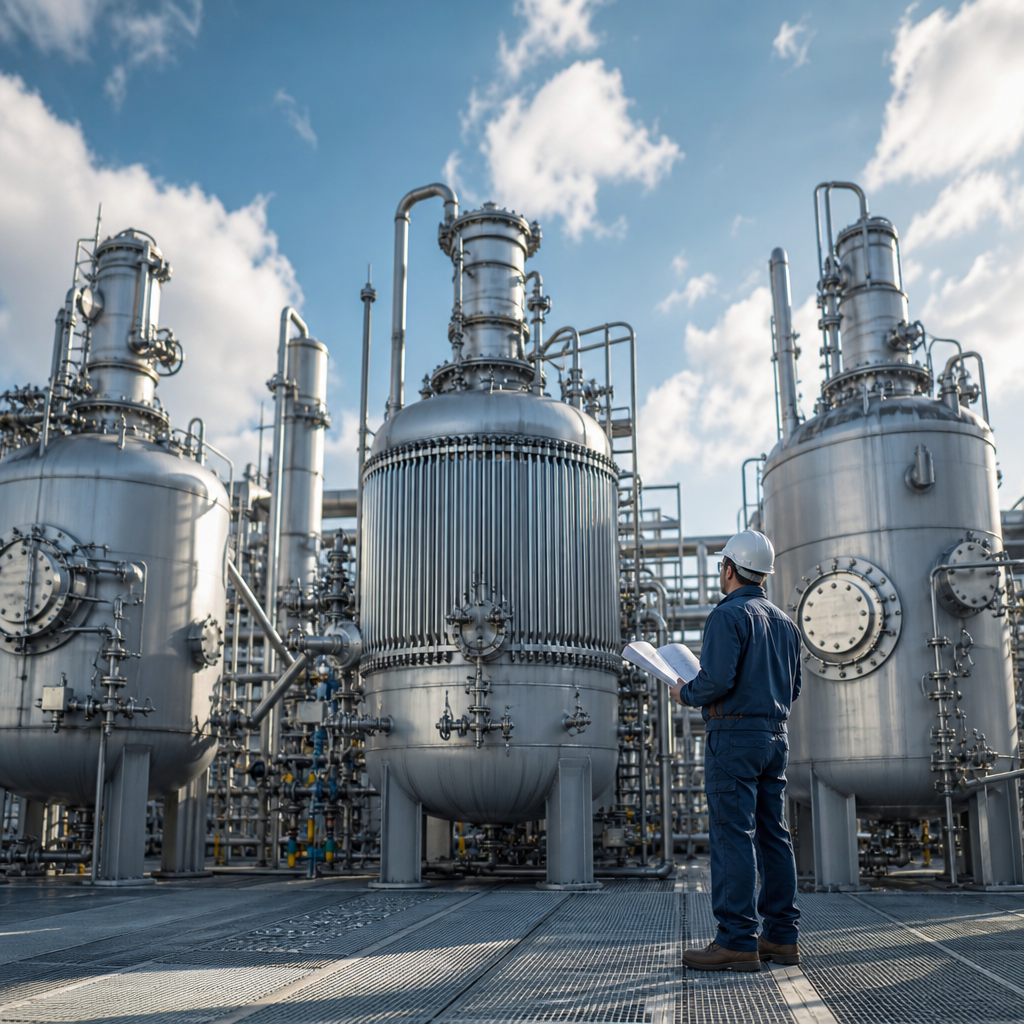
Industrial chemistry is built on one foundational truth: the reactor is the heart of every process. Whether you are manufacturing pharmaceuticals, refining petroleum, synthesizing polymers, or treating wastewater, the type of reactor you choose determines the efficiency, safety, scalability, and economics of your entire operation. Understanding how different reactors function — and when to deploy each — is not just academic knowledge. It is a practical engineering discipline that separates profitable plants from costly failures.
Why Reactor Selection Is a Critical Engineering Decision
Every chemical reaction has a personality. Some reactions are fast and exothermic, releasing heat rapidly and demanding precise temperature control. Others are slow, equilibrium-limited processes that require extended residence times and careful pressure management. The reactor you select must match the kinetics, thermodynamics, and physical characteristics of the reaction it hosts. A mismatch between reactor design and reaction requirements leads to poor yields, unsafe operating conditions, and expensive retrofits down the line.
Beyond chemistry, reactor selection is also shaped by throughput requirements, available footprint, regulatory constraints, and capital budget. A small-batch pharmaceutical manufacturer has entirely different needs from a continuous-flow petrochemical refinery. This is why engineers invest significant time in process modeling and pilot testing before committing to a full-scale reactor configuration.
The Major Categories of Industrial Reactors
Batch Reactors
Batch reactors are among the oldest and most versatile reactor configurations in industrial chemistry. Reactants are loaded into a vessel, the reaction proceeds over a defined period, and the products are then removed. This approach offers exceptional flexibility — the same vessel can be used for multiple products simply by changing the recipe and cleaning protocol. Batch reactors are especially common in specialty chemicals, food processing, and pharmaceutical manufacturing, where product diversity and small production volumes make continuous processing impractical.
The primary drawback of batch processing is its inherent inefficiency at scale. Each cycle involves loading, reacting, unloading, and cleaning — all of which consume time without producing output. For high-volume commodity chemicals, this makes batch reactors economically unattractive compared to continuous alternatives.
Continuous Stirred Tank Reactors (CSTRs)
The continuous stirred tank reactor operates with a constant feed of reactants and a continuous withdrawal of products. Inside the vessel, an agitator maintains near-perfect mixing, which means the concentration of reactants throughout the tank is essentially uniform and equal to the outlet concentration. This characteristic makes CSTRs particularly well-suited for liquid-phase reactions where temperature uniformity is critical and where the reaction rate is not highly sensitive to concentration.
CSTRs are frequently used in series — a cascade of tanks where the outlet of one becomes the inlet of the next. This arrangement improves conversion rates while preserving the operational simplicity that makes individual CSTRs so appealing. They are widely deployed in wastewater treatment, fermentation, and polymerization processes.
Plug Flow Reactors (PFRs)
In a plug flow reactor, reactants move through a tubular vessel in an orderly, piston-like fashion. There is no back-mixing — each parcel of fluid experiences the same residence time and follows the same concentration profile from inlet to outlet. This makes PFRs highly efficient for fast reactions and for situations where high conversion is required. They are commonly found in petroleum cracking, ammonia synthesis, and gas-phase catalytic reactions.
The tubular geometry of PFRs also makes heat management more straightforward in some configurations, particularly when the reactor is jacketed or immersed in a heat-exchange medium. This structural simplicity, combined with high throughput capability, makes PFRs a cornerstone of large-scale continuous chemical manufacturing.
Fixed Bed and Fluidized Bed Reactors
Heterogeneous catalytic reactions — where the catalyst exists in a different phase from the reactants — require specialized reactor designs. Fixed bed reactors pack solid catalyst particles into a vessel through which gas or liquid reactants flow. They are robust, simple to operate, and widely used in processes like hydrocracking, methanol synthesis, and selective oxidation.
Fluidized bed reactors take a different approach: the catalyst particles are suspended in an upward-flowing gas stream, creating a dynamic, fluid-like bed. This improves heat and mass transfer significantly, making fluidized beds ideal for highly exothermic reactions and for processes where catalyst regeneration must occur continuously. Fluid catalytic cracking in oil refining is perhaps the most iconic application of this technology.
Fluid Dynamics and Reactor Performance: What the Research Shows
Modern reactor design increasingly relies on computational fluid dynamics (CFD) and advanced simulation tools to predict performance before physical construction begins. Research published in peer-reviewed engineering literature has demonstrated that flow patterns inside reactors — including turbulence, recirculation zones, and dead volumes — have a profound impact on conversion efficiency and product selectivity. Engineers working on reactor optimization can consult peer-reviewed studies on fluid dynamics and process modeling to inform design decisions with empirical data rather than assumptions alone.
Connecting Reactor Design to Broader Process Engineering
Reactor selection does not happen in isolation. It is one component of a broader process engineering challenge that includes heat integration, separation systems, materials handling, and utilities management. Just as the choice of reactor affects downstream separation equipment, the design of ancillary systems — including pumps, heat exchangers, and fluid distribution networks — feeds back into reactor performance. For example, engineers designing outdoor or semi-industrial fluid systems often draw on principles similar to those used in decorative water management. Those interested in creative fluid system applications can explore innovative ways to use submersible fountain systems as an accessible entry point into understanding flow dynamics and pump selection at smaller scales.
International Process Plants: A Trusted Source for Reactor Equipment
For organizations looking to acquire reactor equipment — whether for a greenfield project, a capacity expansion, or a process upgrade — sourcing the right equipment at the right price is a significant challenge. International Process Plants has established itself as a leading resource in this space, offering an extensive inventory of used and refurbished industrial process equipment. Their expertise spans the full spectrum of reactor configurations, from batch vessels to continuous flow systems, and their team brings deep technical knowledge to every transaction. Whether you are evaluating options or ready to procure, their platform provides the guidance and inventory access that serious process engineers require.
Making the Right Choice for Your Process
Understanding chemical reactor types is the essential first step toward making informed decisions about process design, equipment procurement, and operational strategy. Each reactor configuration carries its own set of trade-offs, and the best choice depends on a careful analysis of reaction kinetics, production scale, product specifications, and economic constraints. There is no universal answer — only the right answer for your specific process.
Conclusion
The diversity of industrial reactor designs reflects the extraordinary complexity of chemical manufacturing. From simple batch vessels to sophisticated fluidized bed systems, each reactor type has earned its place in the engineer’s toolkit through decades of industrial application and continuous refinement. As processes grow more complex and sustainability demands intensify, the ability to select, source, and operate the right reactor will remain one of the most valuable competencies in chemical engineering. Investing in this knowledge — and in the right equipment partnerships — pays dividends across the entire lifecycle of a process plant.