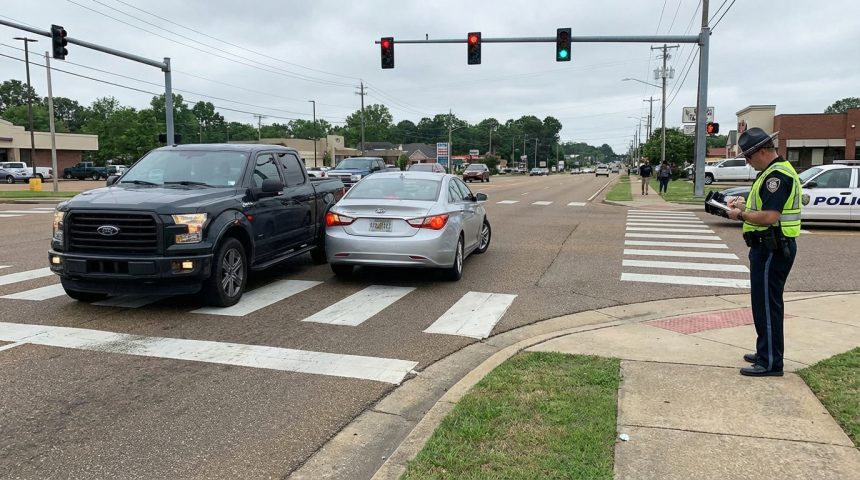
Most car accident claims require expert testimony or extensive reconstruction to establish that the at-fault driver breached the duty of reasonable care. When the at-fault driver violated a specific Mississippi traffic statute, that work is already done. Mississippi courts apply the negligence per se doctrine, which holds that a driver who violates a statute enacted to protect public safety has committed negligence as a matter of law. The violation is the breach. For Tupelo car accident victims whose crashes resulted from a red light violation, an illegal left turn, or a distracted driving offense, this doctrine shifts the liability analysis from a contested question of what reasonable care required to a documented question of what the driver actually did.
How Negligence Per Se Works in Mississippi
The negligence per se doctrine applies when three conditions are met. The defendant violated a statute. The plaintiff belongs to the class of persons the statute was designed to protect. And the injury is the type the statute was designed to prevent. Mississippi traffic statutes are enacted specifically to protect road users from vehicle crashes, which means virtually every substantive traffic code violation satisfies all three conditions when it results in a collision. A driver who ran the red light at the intersection of Gloster Street and McCullough Boulevard has violated Mississippi Code Section 63-3-1007, which governs obedience to traffic control devices, and that violation establishes their negligence without requiring the injured person to prove anything further about what a careful driver would have done.
Working with a Tupelo personal injury car accident attorney in the first days after a crash means identifying which specific statute the at-fault driver violated and building the documentary record that establishes the violation before any other evidence is disputed.
Mississippi’s Distracted Driving Law and What It Creates
Mississippi Code Section 63-3-1213 prohibits the use of a handheld wireless communication device while operating a motor vehicle. A driver who was texting or holding a phone to their ear at the time of a Tupelo crash has violated this statute, and that violation is negligence per se. Establishing it requires the driver’s phone records, which show the specific timestamp of any call or message sent in the period surrounding the crash. Those records are obtainable through a subpoena to the carrier once litigation is initiated, and they produce some of the most direct and least contestable evidence available in modern car accident cases. A text message sent at the moment of impact is not a matter of interpretation.
Mississippi’s Pure Comparative Fault and Why It Matters Here
Mississippi applies pure comparative fault, meaning an injured driver can recover regardless of their own share of responsibility for the crash. The recovery is reduced proportionally by whatever fault percentage the jury attributes to the injured person, but no percentage bars the claim entirely. When the at-fault driver’s negligence per se is established through a documented traffic violation, the comparative fault argument the insurer raises against the injured driver operates in a context where the other driver’s breach is already a legal conclusion. The jury’s task is not to determine whether that driver was negligent but to determine how much of the total fault each party bears, and a driver whose negligence was per se starts that conversation in a significantly weaker position than a driver whose negligence is merely alleged.
The Evidence That Establishes the Violation
Proving a traffic violation requires the same evidence that proves any other aspect of a car accident claim, and most of it exists only briefly after the crash. Traffic camera footage from the intersection where the violation occurred overwrites within 24 to 72 hours in most Tupelo commercial areas. The event data recorder in the at-fault vehicle captures the speed and braking data that corroborates or contradicts the driver’s account of their conduct. The police report documents the investigating officer’s observations and any citations issued, and officers who issue citations for specific code violations have made a preliminary determination that the violation occurred. Each of these sources requires prompt preservation action.
The Mississippi Department of Transportation’s traffic safety resources document crash patterns on Lee County’s road network, including the specific intersection and corridor types where the violations that produce negligence per se most commonly occur. Understanding where a Tupelo crash fits within those documented patterns is part of the liability analysis that begins in the first 48 hours after the collision.