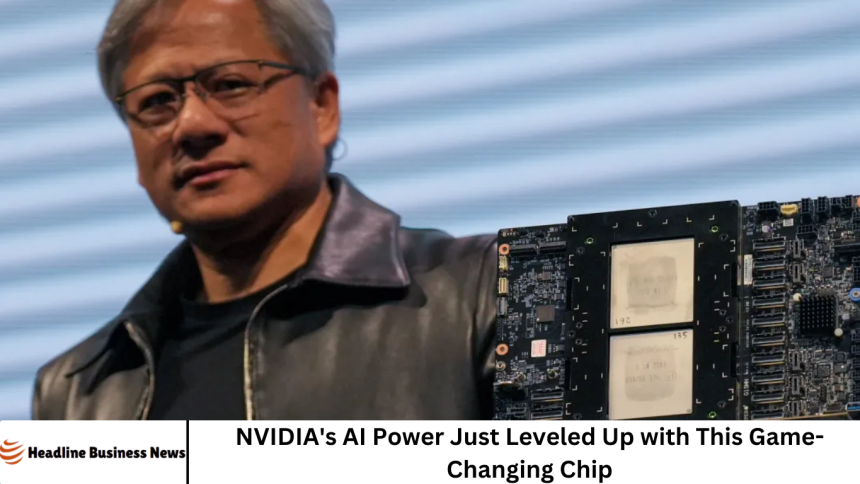
In the rapidly evolving world of artificial intelligence (AI), processing power is king—and NVIDIA has once again claimed the throne. With the release of its Blackwell Ultra GPU, NVIDIA is setting a new standard in AI acceleration. This next-generation chip promises staggering performance improvements, cutting-edge architecture, and full backward compatibility with the tools developers know and trust.
In this article, we’ll dive deep into why the NVIDIA Blackwell Ultra is being hailed as a breakthrough in AI hardware, what makes it superior to its predecessors, and how it will transform industries ranging from machine learning and robotics to generative AI and cloud computing.
More Read: U.S. Natural Gas Consumption Set to Hit Record High in 2025, Says EIA
The Blackwell Ultra GPU: A Technical Overview
NVIDIA’s Blackwell Ultra is a major leap forward in its AI hardware roadmap. The chip builds on the success of the original Blackwell architecture but delivers significant advancements in both performance and efficiency.
Key specifications include:
- 640 5th-Generation Tensor Cores
- 15 PetaFLOPS of NVP4 Compute Power
- 208 Billion Transistors
- Enhanced Memory Bandwidth
- 2.6x the Transistor Count of the Hopper GPU
These numbers reflect a deliberate effort by NVIDIA to stay ahead of the curve, as AI models continue to balloon in size and complexity.
Performance Highlights: 15 PetaFLOPS and Beyond
With 15 PetaFLOPS of AI performance, the Blackwell Ultra delivers unprecedented compute capability. This makes it an ideal chip for training massive neural networks and deploying ultra-fast inference engines.
To put this into perspective, a single Blackwell Ultra GPU can outperform multiple GPUs from the previous generation—reducing training time and energy consumption across a range of applications. This level of performance is especially critical in industries where speed and accuracy are paramount, such as healthcare, finance, autonomous vehicles, and national security.
208 Billion Transistors: The Power of Scale
One of the most mind-blowing features of the Blackwell Ultra is its 208 billion transistors. That’s 2.6x more than the Hopper architecture, which was already considered a technological marvel.
This dramatic increase in transistor count allows for:
- More processing units
- Higher memory bandwidth
- Better parallelization of AI tasks
- Reduced latency during multi-stage inference
These benefits are not just theoretical—they translate to real-world advantages for developers and data scientists working on the bleeding edge of AI.
5th-Gen Tensor Cores: Built for AI
The fifth-generation Tensor Cores featured in Blackwell Ultra are specifically optimized for modern AI workloads. Whether you’re training deep neural networks, generating synthetic data, or fine-tuning LLMs, these Tensor Cores offer:
- Increased precision for floating-point and integer operations
- Higher throughput for matrix multiplications
- Support for sparsity, improving efficiency
- Enhanced compatibility with transformer-based architectures
This makes the chip particularly well-suited for generative AI, which depends heavily on fast, accurate matrix computation.
Backwards Compatibility: CUDA Programming Made Easy
One of the standout features of Blackwell Ultra is its continued support for NVIDIA’s CUDA programming model—a framework developers have used for nearly 20 years.
For developers and enterprises, this means:
- No need to rewrite code
- Easy migration from older GPUs
- Immediate access to optimized libraries
- Ongoing support from the extensive CUDA ecosystem
This kind of compatibility is rare in the hardware world and is one of the reasons NVIDIA continues to dominate the AI processing space.
Comparing Blackwell Ultra to Hopper
Here’s a quick comparison between Blackwell Ultra and its predecessor, Hopper:
| Feature | Hopper GPU | Blackwell Ultra GPU |
|---|---|---|
| Transistor Count | ~80 billion | 208 billion |
| Tensor Cores | 4th-Gen | 5th-Gen |
| AI Compute Power | ~6 PetaFLOPS | 15 PetaFLOPS |
| Architecture | Hopper | Blackwell |
| CUDA Support | Yes | Yes |
| Efficiency | High | Significantly Higher |
This comparison makes it clear that Blackwell Ultra isn’t just a minor iteration—it’s a quantum leap in GPU performance and efficiency.
Impact on AI Development
With the rollout of Blackwell Ultra, developers now have the tools to build:
- Larger, more complex models
- Faster real-time inference engines
- More efficient data pipelines
- Advanced simulations for robotics, healthcare, and climate science
More power means fewer limitations, and that translates into more rapid innovation across the board.
Blackwell Ultra and Generative AI
Generative AI—whether in the form of image generation, video synthesis, or natural language generation—demands enormous processing capabilities. Blackwell Ultra delivers on all fronts.
Its high Tensor throughput, massive transistor count, and optimized memory handling allow for real-time processing of extremely large models. As companies race to build the next GPT-5 or open-source LLM, Blackwell Ultra will be at the heart of these developments.
With reduced latency and increased power efficiency, this chip is poised to become the backbone of generative AI infrastructure across the globe.
The Future of AI Hardware
The Blackwell Ultra isn’t just a single product—it represents the future of NVIDIA’s roadmap. It signals the company’s ongoing investment in scalable AI compute, developer-friendly ecosystems, and sustainable performance growth.
As competitors like AMD and Intel try to catch up in the AI accelerator market, NVIDIA is doubling down with advanced engineering and a cohesive software-hardware strategy that few can match.
Expect to see Blackwell Ultra GPUs integrated into next-gen data centers, supercomputing clusters, and cloud AI services in the near future.
Frequently Asked Question
What is the new NVIDIA chip that’s leveling up AI performance?
The latest chip is the NVIDIA Blackwell Ultra GPU, a next-generation AI accelerator designed to deliver unmatched performance in AI training and inference. It features 640 5th-gen Tensor Cores and achieves up to 15 PetaFLOPS of compute power.
How does Blackwell Ultra compare to previous NVIDIA GPUs like Hopper?
Blackwell Ultra outperforms the Hopper GPU by a wide margin. It has 208 billion transistors—2.6x more than Hopper—and delivers over 2x the AI performance, making it NVIDIA’s most powerful AI chip to date.
What makes Blackwell Ultra ideal for AI and machine learning tasks?
Its 5th-generation Tensor Cores, high memory bandwidth, and optimized NVP4 compute architecture make it ideal for deep learning, large language models (LLMs), generative AI, and other complex machine learning applications.
Is the Blackwell Ultra GPU compatible with existing software and tools?
Yes, the Blackwell Ultra is fully compatible with NVIDIA’s CUDA programming model, which developers have used for nearly two decades. This allows for easy migration and integration with existing AI pipelines.
What industries will benefit most from the Blackwell Ultra GPU?
Industries like healthcare, autonomous vehicles, financial services, cloud computing, and generative AI will benefit greatly from Blackwell Ultra’s processing power, reduced latency, and energy efficiency.
When will the Blackwell Ultra GPU be available to the public?
While NVIDIA has announced the chip, exact release dates vary depending on OEM partnerships and cloud providers. Availability is expected to ramp up throughout late 2025 and early 2026.
Can Blackwell Ultra improve generative AI performance?
Absolutely. The Blackwell Ultra is specifically optimized for transformer-based models, offering faster training times and more efficient inference for generative AI applications such as image synthesis, LLMs, and video generation.
Conclusion
The launch of the NVIDIA Blackwell Ultra GPU marks a significant milestone in the evolution of AI hardware. With its record-breaking 15 PetaFLOPS of compute power, 208 billion transistors, and seamless compatibility with existing CUDA tools, it offers the perfect blend of power, performance, and developer convenience. For enterprises, researchers, and developers looking to stay ahead in the AI race, Blackwell Ultra isn’t just a smart investment—it’s a game-changer. As AI continues to shape our world, one thing is clear: NVIDIA’s AI power has just leveled up.