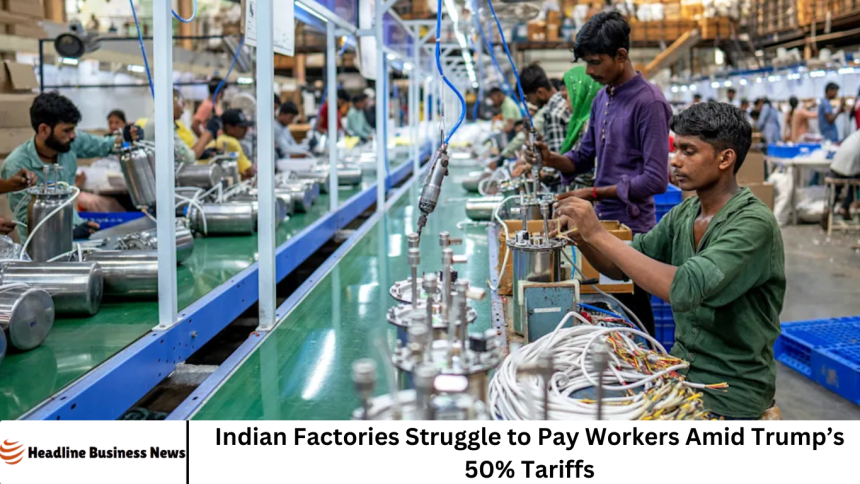
Indian factories, especially those involved in exports, are facing severe financial pressure due to the United States imposing a steep 50% tariff on key Indian goods. This sudden change in trade policy, initiated under former President Donald Trump, has disrupted supply chains, led to suspended orders, and placed tens of thousands of manufacturing jobs at risk.
Indian exporters, particularly in the garment, textile, and manufacturing sectors, now face rising costs, reduced competitiveness, and an uncertain future.
More Read: Promoting National Savings and Investment Growth
Background: India-US Trade Relations and Tariffs
India and the United States have traditionally maintained strong trade ties. The U.S. is India’s largest export market, with bilateral trade totaling over $118 billion in 2024, according to the Ministry of Commerce and Industry.
India exports a wide variety of goods to the U.S., including:
- Ready-made garments
- Leather goods
- Gems and jewelry
- Shrimp and seafood
- Pharmaceuticals
- Machinery and electronics
However, in 2025, the U.S. government imposed a 50% tariff on several Indian exports. These tariffs are part of a broader policy shift aimed at protecting domestic industries, countering trade imbalances, and penalizing nations that engage in strategic relationships with adversaries such as Russia.
While framed as a geopolitical tool, these tariffs have direct and damaging consequences on Indian small and medium-sized enterprises (SMEs), particularly in textile hubs like Tiruppur, Surat, and Panipat.
The Impact on Indian Manufacturing Hubs
Tiruppur: India’s Knitwear Capital in Crisis
Tiruppur, located in Tamil Nadu, accounts for nearly one-third of India’s $16 billion garment exports. Known for producing knitwear for global giants like Walmart, Target, GAP, and Zara, the city’s garment factories have seen a sharp decline in U.S. orders.
In one factory run by N. Krishnamurthy, only a handful of sewing machines remain active. The rest are idle, as pending orders dry up and new contracts from American clients vanish.
“September onwards, there may be nothing left to do,” Krishnamurthy says. “We hired 250 new workers in anticipation of increased demand, and now they’re all on standby.”
Factories like his have not only paused expansion but are also struggling to pay existing staff. Some business owners are using personal savings or loans to cover wages temporarily, but they admit it’s unsustainable.
Panipat and Surat: From Boom to Uncertainty
Panipat, the home of India’s home textiles industry, and Surat, a major hub for synthetic textiles and diamonds, are experiencing similar struggles. Workers in these regions report reduced working hours, layoffs, and factory shutdowns.
With American buyers turning to cheaper alternatives in Vietnam, Bangladesh, and Mexico, Indian manufacturers are rapidly losing market share.
The Human Cost: Factory Workers Face Layoffs and Wage Delays
The most devastating impact of these tariffs is on the labor force. India’s textile industry alone employs over 45 million people, many of them low-income, semi-skilled workers who depend on regular wages to support their families.
Factories that once operated three shifts a day are now down to one or none. Some factories are holding millions of dollars in unsold inventory, awaiting clarity from clients or hoping for trade policy reversals.
Siva Subramaniam, owner of Raft Garments, shared his struggle:
“We were hoping India would sign a trade deal with the U.S. Now our production line is frozen. I have $1 million worth of goods lying unsold. How will I pay my workers if this continues?”
This sentiment echoes across hundreds of factories where owners must now choose between paying salaries and staying afloat.
Why the 50% Tariff Matters So Much
At a 50% tariff rate, an Indian-made shirt that once retailed for $10 in the U.S. now costs $16.40, far more expensive than similar items from China ($14.20), Bangladesh ($13.20), or Vietnam ($12.00).
Even if tariffs drop to 25%, India would still struggle to remain competitive in the fast-paced global apparel market.
Tariff Comparison Table:
| Country | Average Cost of Shirt (Post-Tariff) |
|---|---|
| India | $16.40 |
| China | $14.20 |
| Bangladesh | $13.20 |
| Vietnam | $12.00 |
The sharp increase in prices makes Indian goods less attractive to U.S. buyers, many of whom are already dealing with their own supply chain disruptions and inflation pressures.
Broader Economic Repercussions
Foreign Exchange and GDP Impact
With the U.S. being India’s top export destination, reduced exports also impact foreign exchange reserves, trade balance, and GDP growth. India’s export sector contributes nearly 18% of the GDP, and prolonged downturns could stunt economic recovery post-COVID-19 and amidst global slowdowns.
Investor Sentiment and Market Diversification
Investor confidence is also shaken. While India has tried to offset losses by engaging in trade negotiations with Europe, Australia, UAE, and Southeast Asian nations, shifting trade routes and relationships takes time.
Ajay Srivastava from the Global Trade Research Initiative notes:
“We can expect a significant diversion of trade. U.S. buyers are already moving to Mexico, Vietnam, and Bangladesh.”
Unless India can quickly reposition itself as a value-driven, reliable exporter in alternate markets, the long-term damage may be deep.
Government Response and Relief Measures
Duty Waivers and Incentives
To soften the blow, the Indian government has introduced several measures:
- Suspension of import duties on raw materials for textile exporters.
- Expansion of the Production-Linked Incentive (PLI) scheme for labor-intensive sectors.
- Export Credit Guarantee Corporation (ECGC) support to ease liquidity.
- Fast-tracking of pending GST refunds to ensure cash flow.
However, many exporters believe these steps, while welcome, are not enough.
“It’s too little, too late. Orders have already been lost. Clients are moving on,” said a factory owner in Tiruppur.
Trade Diplomacy
India is now pushing for:
- A bilateral trade deal with the U.S., though progress remains slow.
- Strengthening ties with Middle East, Africa, and Latin America for apparel and jewelry exports.
- Seeking World Trade Organization (WTO) intervention, though this process is lengthy and often inconclusive.
Domestic Market: A Lifeline or a Mirage?
With exports drying up, many manufacturers are eyeing the domestic Indian market, especially during festive seasons like Diwali. While this offers short-term relief, the low purchasing power and over-saturated market pose significant challenges.
Unlike American retail chains that place bulk orders months in advance, the Indian market is fragmented and less predictable, limiting profitability and scalability.
What Lies Ahead: Challenges and Opportunities
Short-Term Challenges
- Mounting debt and wage arrears
- Reduced factory utilization
- Shift in U.S. buyer preferences
- Lack of quick alternative markets
Long-Term Opportunities
- Diversification of export destinations
- Adoption of automation and lean manufacturing
- Building resilience through vertical integration
- Rebranding Indian exports as high-quality, ethical, and sustainable
India must also work towards making trade agreements with favorable terms and reducing dependency on any single country, even a major market like the U.S.
Frequently Asked Question
Why did the U.S. impose a 50% tariff on Indian goods?
The U.S. imposed the 50% tariff as part of a broader protectionist trade policy under former President Donald Trump. The move was intended to reduce trade deficits, support domestic manufacturing, and penalize countries engaging with U.S. adversaries, such as Russia. India was targeted due to its defense and energy ties with Russia, as well as ongoing trade imbalances.
Which Indian industries are most affected by the 50% tariffs?
The most affected industries include:
- Textiles and garments (especially in hubs like Tiruppur and Surat)
- Gems and jewelry
- Seafood and shrimp exports
- Leather goods
- Engineering products and machinery
These sectors heavily rely on U.S. orders, and the tariffs have made Indian products significantly more expensive for American buyers.
How are the tariffs impacting Indian factory workers?
Many factories are unable to fulfill or receive U.S. orders, leading to:
- Layoffs and job losses
- Delayed wages
- Idle production lines
- Hiring freezes
Factory owners report an inability to pay workers, with some forced to shut down operations or cut shifts to stay afloat.
What is the impact on Indian exports to the U.S.?
Exports to the U.S. have sharply declined in affected categories. Indian-made goods are now less competitive compared to products from countries like Vietnam, Bangladesh, and Mexico, which enjoy lower tariffs. This has led to reduced order volumes, revenue losses, and surplus unsold inventory.
What is the Indian government doing to support affected exporters?
The Indian government has announced several measures:
- Suspension of import duties on raw materials
- Incentives under the Production-Linked Incentive (PLI) scheme
- Trade diversification efforts with countries in Europe, Asia, and the Middle East
- Faster GST refunds and credit support
However, many exporters believe these steps are not enough to offset the losses caused by the steep U.S. tariffs.
Can Indian factories shift focus to the domestic market?
Some manufacturers are pivoting to the Indian domestic market, especially during festive seasons like Diwali. However, limited consumer purchasing power and a saturated local market make it difficult to fully absorb the losses from U.S. exports.
Is there any hope for a U.S.-India trade agreement to remove the tariffs?
Talks between India and the U.S. have been ongoing, but no concrete deal has been finalized to reverse or reduce the tariffs. While there is hope for improved trade relations under future administrations, the timeline and outcome remain uncertain.
Conclusion
The imposition of 50% tariffs on Indian goods by the U.S. is more than a trade decision — it’s a potential tipping point for millions of Indian workers and thousands of export-based businesses. As factories lie silent and fabric gathers dust, the real price is being paid by the people behind the machines. While the Indian government is taking steps to mitigate the crisis, a larger, more coordinated policy response is essential. Rebuilding trust with global partners, strengthening internal capacity, and ensuring worker security must now be national priorities.