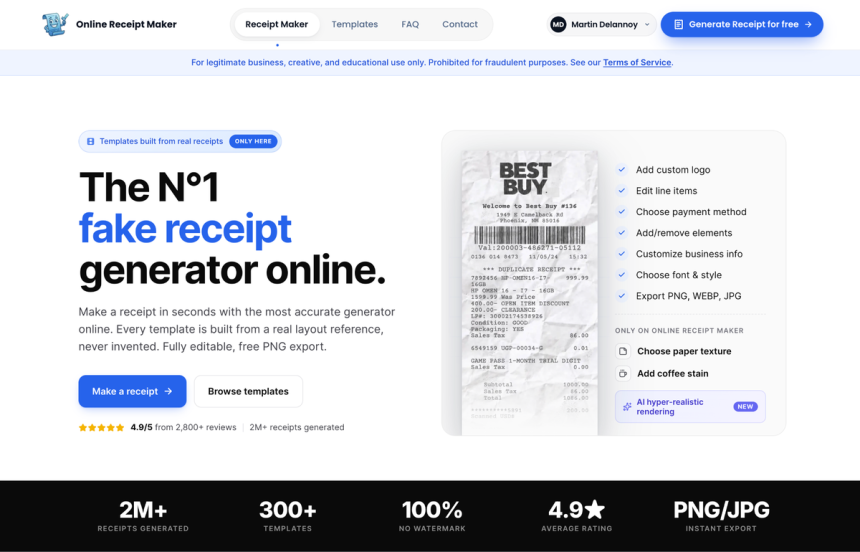
The assumption behind most advice on making a receipt is that you own a design program and know how to drive it. Plenty of people who need a believable receipt, a prop assistant, a teacher, a tester, a small business owner, a content creator, do not. The good news is that Photoshop has not been necessary for this for a while. You can make a fake receipt that looks genuinely real, in under a minute, in your browser, with no software and no design skill at all. Here is how.
Why you do not need design software
The hard part of building a receipt by hand was never the typing, it was getting the structure right: the correct monospaced font, the column alignment, a plausible barcode, the brand specific layout. Those are exactly the things a browser based generator already has, because it starts from a template reverse engineered from a real receipt. The structural work is done. All you do is change the content, which needs no design ability whatsoever. The skill barrier that made people reach for Photoshop simply is not there anymore.
The browser based way, step by step
Using Online Receipt Maker as the example, the flow is four plain steps. First, pick a template that matches the kind of store you need, which immediately gives you the correct layout and format. Second, edit the fields, swapping in your own items, prices, date, store address and payment method while the totals calculate themselves. Third, add a touch of realism, switching the paper texture, adding a stain or crease, or running the ink variation pass so it does not look suspiciously crisp. Fourth, export a clean image with one click. No layers, no fonts to install, no menus to learn.
That is the whole thing, and once you have done it once it takes well under a minute.
What this replaces
Compare that to the manual route. In a design program you would open a blank canvas, set up a narrow column, hunt for a font that resembles thermal output, lay out the header by hand, type each line item with careful alignment, attempt a barcode and fight the spacing into shape. Thirty minutes to an hour, for one receipt, assuming you know the software. The browser tool collapses all of that into picking and editing, and it makes fewer mistakes because the structure is already correct.
Keeping it believable without the skills
You do not need design experience to avoid the common tells, just a little attention. Make sure the math reconciles, which the tool does for you. Use a store address that could exist and a timestamp inside opening hours. Keep prices sensible for the date. Match the format to the store rather than forcing a generic look. These are judgement calls, not design tasks, and anyone can make them.
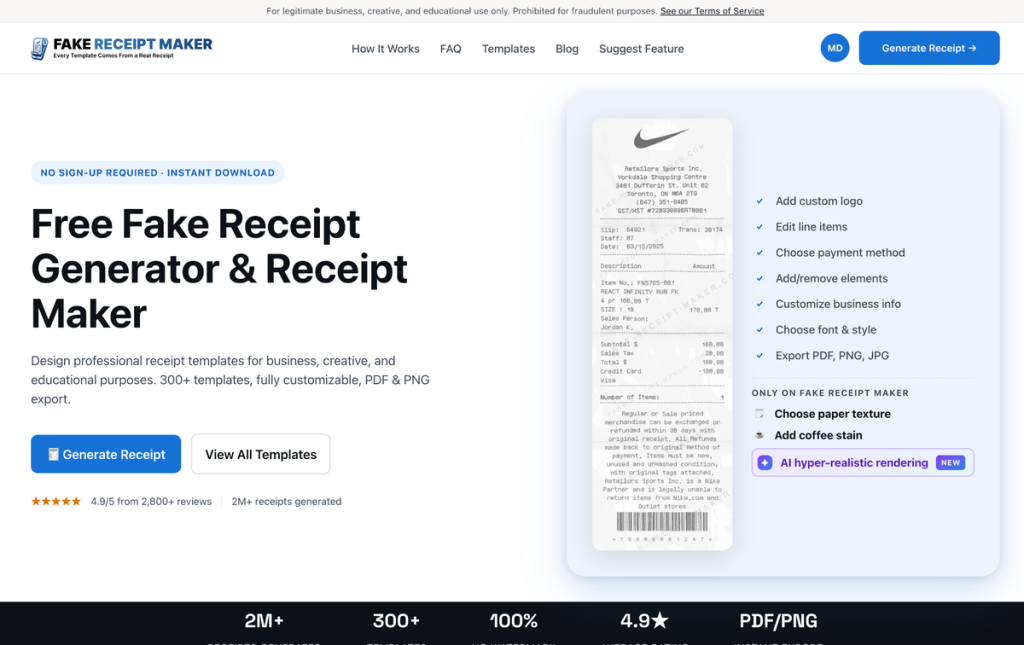
If you want the simplest possible flow, Fake Receipt Maker strips it down further, with no sign up, three steps and PDF or image export. For someone who has never touched a design tool and just wants a believable receipt, it is about as approachable as it gets.
Works anywhere
Because it runs in the browser, there is nothing to install and it works on a phone, tablet or laptop equally. You can make a receipt from a coffee shop on your phone or at your desk between tasks. That accessibility is part of the point. The people who most often need a quick believable receipt are rarely designers, and a browser tool meets them where they are.
Doing it from your phone
One underrated advantage of skipping design software is that the whole task moves to your phone. Because a browser based maker has no install and a touch friendly editor, you can make a believable receipt from wherever you are: on set between takes, in a classroom before a lesson, at a meeting while prepping a demo. The flow is the same as on a laptop, pick a template, edit the fields, add a little realism, export, and the result drops straight into your camera roll ready to use. For the people who most often need a quick receipt, prop assistants, teachers, creators, founders, who are rarely sitting at a design workstation when the need arises, this mobility is a large part of why the browser approach has replaced the design program entirely.
A note on legitimate use
Skipping Photoshop does not change what a receipt is for. These tools are built for legitimate creative, business, educational and testing work, and both sites state that openly on their own pages while prohibiting fraudulent use. A receipt for a prop, a mockup, a lesson, a demo or a test is exactly the intended use. Using a fabricated receipt to deceive anyone in a real transaction is illegal whatever made it, by hand or in a browser.
Bottom line
Making a fake receipt has not required Photoshop or any design skill for a while. A browser based generator built from real templates does the structural work for you, leaving four simple steps: pick, edit, add a little wear, export. It is faster, more accurate and open to everyone, not just people who own design software. Choose a tool whose templates come from real scans, pay attention to the math and the context, and you will have a believable receipt in under a minute without ever opening a design program. The skill that used to live behind expensive software and years of practice now lives behind a few sensible choices anyone can make, which is exactly why the browser tool has become the default rather than the fallback.