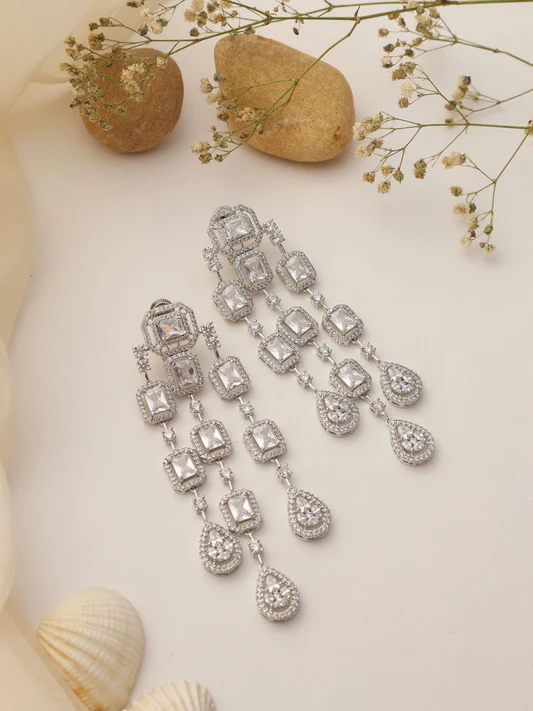
Most earring disappointment has nothing to do with quality and everything to do with the right proportion. A pair that looked striking on a model can sit awkwardly against a different jawline. Shoppers browsing for modern Indian earrings often select by trending popularity alone, then wonder why the finished look feels slightly off in their taken photographs.
The fix is simpler than most buyers expect. Once you know how your face shape interacts with length and width, choosing modern Indian earrings becomes a matter of matching geometry rather than guessing. That single shift turns browsing into a confident purchase and makes every styling decision afterward easier to judge.
Why Face Shape Changes the Way an Earring Reads
Geometry Registers before Detail Does: The eye reads the outline of an earring before it registers stonework or finish. A long, narrow silhouette pulls attention downward and adds apparent height, while a broad, rounded one spreads attention outward. Face shape decides which effect flatters you and which one exaggerates a feature you would rather balance.
Late Decisions Narrow Your Options: Leaving earring selection to the final week of wedding preparation removes any chance to compare shapes against your own proportions. In everyday retail practice, jewelry consultants regularly meet shoppers who buy whatever remains available and later regret the fit. Principles drawn from facial anthropometry explain why a rushed choice rarely photographs well.
Earring Shapes That Balance Round and Longer Faces
Slim Drops Add Length to Round Faces: Round faces gain definition from earrings that create vertical movement rather than added width. Slim jhumkas with a narrow dome and tapered chandelier drops pull the eye downward and lengthen the visual line. Among modern Indian earrings, this long and narrow category delivers the most dependable flattery for round-faced buyers.
Wide Chandbalis Balance Longer Faces: Longer faces balance best under earrings that add horizontal weight near the jaw. A broad chandbali with a generous crescent sweep introduces width exactly where a narrow face benefits from it. Oval faces still carry most silhouettes comfortably, though very long linear drops can stretch the proportion further than intended.
Weight Placement for Heart and Square Faces
Heart Shapes Balance with Fullness Below: Heart-shaped faces narrow toward the chin, so earrings carrying their volume low restore balance across the lower half. Chandbalis with a weighted lower fringe and jhumkas with a full, rounded bell widen the visual line where it is needed. Designs that flare at the top emphasize a broader forehead instead.
Square Jawlines Soften under Curves: Square faces soften when the earring outline curves rather than repeating the angle of the jaw. Rounded jhumkas and circular chandbalis supply the contrast a strong jawline responds to. Highly polished gold-tone surfaces produce stronger specular reflection along that edge, so a matte or textured finish often photographs more kindly.
Studs, Statement Pieces, and the Role Each One Plays
Studs Work as a Neutral Base: Studs and small hoops sit close to the ear and stay neutral against every face shape, making them the safest daily choice. They rarely transform a look, though they never fight one either. Building a collection of modern Indian earrings around a neutral base frees your statement pairs to do their work.
Statement Pairs Must Complement, Not Compete: A statement pair should complement the face rather than compete with it. Heavy jhumkas deliver drama but can overwhelm delicate features and higher necklines. Chandbalis carry a similar presence with more openness in the design, so they wear lighter on the wearer. Long linear drops read the most modern, though they suit fewer face shapes.
Why a Proportion-Led Pair Keeps Earning Its Place
A Flattering Pair Moves across Occasions: Earrings chosen for proportion get worn far more often than pairs bought on impulse. A chandbali that suits your face carries a mehendi afternoon and a wedding reception equally well, with no styling recalculation needed between them. The pair that only photographed well on someone else stays in the box.
Versatility Outperforms Volume: Two well-matched pairs will serve you better than six chosen at random. Once you know which silhouette flatters your face, every future purchase becomes faster and more accurate, and the cost spread across repeated wear falls sharply. Buyers who shop this way build smaller collections they reach for more regularly.
Practical Checks That Save You from a Poor Match
A short mental checklist prevents most mismatches before payment is made. Running through these points while browsing modern Indian earrings keeps the decision anchored to your own proportions rather than to whatever is trending this month. Each one applies whether you are shopping for a wedding or for everyday festive wear.
- Measure drop length against your jawline, since anything falling below it lengthens the face further.
- Check the widest point of the design, because that dimension controls the horizontal balance it adds.
- Match earring scale to hairstyle, as tied-back styles reveal the full silhouette.
- Consider the neckline first, since a high collar competes directly with a long drop.
- View the pair in daylight, because indoor lighting flattens depth and hides texture.
Letting Your Own Proportions Lead the Choice
Choosing by face shape turns earrings from a gamble into a decision you can trust, and the flattery shows in every photograph. Each season spent buying on trend alone adds another unworn pair to the drawer and delays the moment your collection starts working properly. Browse with your own proportions in mind, or get in touch for styling guidance before your next purchase.