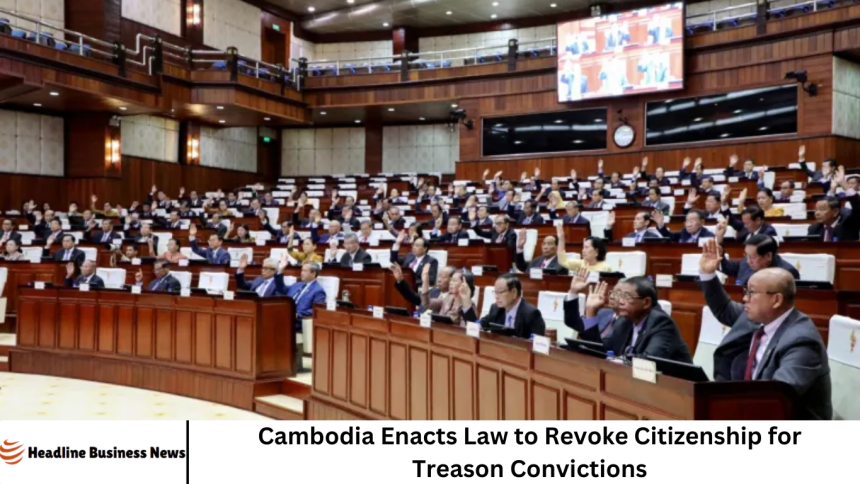
Phnom Penh, Cambodia – In a controversial and significant development, Cambodia has officially enacted a law that empowers the government to revoke the citizenship of individuals convicted of treason. The legislation, which has sparked heated debate both domestically and internationally, marks a bold step in the Southeast Asian nation’s approach to national security and political dissent.
This comprehensive article explores the implications of the new law, its potential impact on civil liberties, reactions from the international community, historical context, and what it means for Cambodia’s future political landscape.
More Read: Motorola’s iconic flip phone gets an AI reboot
Overview of the New Law
In August 2025, Cambodia’s National Assembly passed a controversial bill that grants the government the power to strip individuals of their Cambodian citizenship if they are convicted of treason or related national security offenses. The law applies to both single and dual nationals, raising questions about the risk of rendering individuals stateless.
The ruling Cambodian People’s Party (CPP), which holds a strong majority in parliament, pushed the legislation through with little resistance. Prime Minister Hun Manet’s administration has defended the law as a necessary tool to protect the country from threats posed by “internal enemies” and foreign-backed subversion.
The law comes amid ongoing political tensions and what critics describe as a shrinking space for opposition and dissent in Cambodia.
What Constitutes Treason in Cambodia?
Under Cambodian law, treason is broadly defined. According to the Cambodian Criminal Code, treason can include:
- Attempts to overthrow the government
- Acts of espionage
- Conspiring with foreign entities to undermine national sovereignty
- Organizing or participating in armed rebellion
- Sabotage or terrorism aimed at destabilizing the state
The vagueness of some of these definitions has alarmed legal experts and human rights advocates, who argue that the law can be easily manipulated to target political opponents.
Political Context Behind the Legislation
The new law does not exist in a vacuum. It follows a long pattern of authoritarian consolidation under former Prime Minister Hun Sen, who stepped down in 2023 after nearly four decades in power, handing the reins to his son, Hun Manet.
Since the 2017 dissolution of the main opposition party, the Cambodia National Rescue Party (CNRP), the CPP has faced little organized political competition. The new treason-citizenship law is seen by many as part of a broader effort to neutralize dissent and discourage criticism of the ruling regime.
It also coincides with increased scrutiny of activists, journalists, and civil society leaders who have been critical of the government’s policies on land rights, corruption, and Chinese investments.
Government’s Justification for the Law
The Cambodian government has defended the new legislation as a matter of national security and sovereignty.
“No country can allow traitors to enjoy the same rights as loyal citizens,” said a government spokesperson during a press briefing. “This law is not about punishing political opinions. It is about protecting Cambodia from those who actively seek to harm it.”
Officials also pointed to similar laws in countries like the United Kingdom, France, and Australia, which allow for the revocation of citizenship in extreme cases involving terrorism or treason.
The government insists that the revocation process will be carried out through due legal procedures, including trials and appeals, and is not arbitrary.
Criticism from Human Rights Organizations
The law has drawn swift condemnation from both local and international human rights organizations, who argue that it is a dangerous tool that could be used to suppress dissent and intimidate political opponents.
Human Rights Watch called the law “a grave threat to civil liberties,” warning that it could be weaponized against critics of the government.
Amnesty International raised concerns about the risk of statelessness, particularly for individuals who may not hold a second nationality. The group also noted the lack of independent oversight in the law’s implementation.
The Cambodian Center for Human Rights (CCHR), one of the country’s few remaining independent civil society organizations, issued a statement saying:
“This law is not about national security—it is about consolidating power and silencing those who dare to challenge the status quo.”
International Reactions and Diplomatic Concerns
The law has also caught the attention of foreign governments and international organizations, some of which are major donors and trade partners of Cambodia.
The European Union and the United States have expressed “deep concern” over the potential misuse of the law and urged the Cambodian government to uphold its commitments under international human rights treaties.
The United Nations Human Rights Office has called for a review of the law’s compatibility with the Universal Declaration of Human Rights, particularly the right to nationality and protection from arbitrary deprivation thereof.
Several foreign embassies in Phnom Penh have held closed-door discussions with Cambodian officials to seek clarity on the implementation of the law.
Comparative Analysis: Citizenship Revocation in Other Countries
To understand Cambodia’s new law in context, it is helpful to examine how similar laws are used around the world.
- United Kingdom: Allows revocation of citizenship for those involved in terrorism, provided the individual is not rendered stateless.
- France: Revocation is permitted in extreme cases but rarely used due to legal and human rights concerns.
- United States: Citizenship revocation is extremely rare and typically applies only to naturalized citizens found guilty of serious fraud or treason.
- India: Similar provisions exist but are rarely enforced due to constitutional protections.
What sets Cambodia’s law apart is the broad definition of treason and the lack of independent judicial oversight, making it more susceptible to abuse.
Legal and Constitutional Ramifications
Cambodia’s Constitution guarantees citizenship as a fundamental right, which means that any law revoking it must pass stringent legal tests. Critics argue that the new legislation violates constitutional protections, particularly those related to due process and the presumption of innocence.
Legal scholars have raised questions about whether the law can withstand a challenge in Cambodia’s Constitutional Council, though few expect the judiciary—widely seen as aligned with the ruling party—to overturn it.
Moreover, the lack of clear safeguards raises the possibility of arbitrary or politically motivated revocations, especially in the absence of a transparent appeal process.
Potential Impact on Political Dissidents and Opposition Leaders
The new law could have a chilling effect on political discourse in Cambodia. Already, opposition figures living in exile have expressed fear that the law will be used to target them retroactively.
Prominent exiled leaders like Sam Rainsy and Mu Sochua—both critics of the government—may now face the risk of losing their Cambodian citizenship, further undermining their ability to participate in national politics.
The law may also deter young activists and reformers from speaking out, knowing that political activism could now carry life-altering consequences.
Frequently Asked Question
What does the new Cambodian law on treason and citizenship say?
The new law empowers the Cambodian government to revoke the citizenship of any individual convicted of treason or crimes deemed to endanger national security. This applies to both natural-born and naturalized citizens, including dual nationals. The law was passed by Cambodia’s National Assembly in August 2025.
What acts are considered treason under Cambodian law?
Treason in Cambodia includes:
- Attempts to overthrow the government
- Espionage or collaboration with foreign powers
- Organizing or joining armed rebellions
- Acts that threaten national sovereignty or integrity
- Terrorist or subversive activities
These definitions are broad and open to interpretation, which has raised concerns about political misuse.
Who can be affected by this law?
Anyone convicted of treason or related national security crimes can be affected — this includes politicians, activists, journalists, and even ordinary citizens. Critics fear that opposition leaders and dissidents, especially those in exile, may be targeted first.
Can this law make someone stateless?
Yes, potentially. Although the government claims it will avoid rendering people stateless, critics argue that individuals without dual citizenship could lose all legal nationality protections if stripped of Cambodian citizenship — a violation of international law.
What has been the international response?
International organizations and governments — including the UN, United States, and European Union — have expressed concern, citing risks to human rights, freedom of expression, and due process. Several human rights groups warn that the law may be used to silence dissent.
How does this law compare to similar laws in other countries?
Some countries, like the UK, France, and Australia, have laws that allow revoking citizenship for terrorism or treason. However, these countries:
- Typically limit it to dual nationals
- Have strong judicial safeguards
- Apply the laws rarely and cautiously
Cambodia’s version is more sweeping and vague, with fewer legal protections.
What are the risks of misuse or political abuse?
The main risks include:
- Targeting political opposition
- Suppressing free speech and activism
- Eroding trust in the judiciary
- Creating fear among the population
Without independent oversight, the law could become a tool for political repression rather than a legitimate national security measure.
Conclusion
The enactment of Cambodia’s treason-citizenship revocation law marks a critical turning point in the country’s political trajectory. While the government frames it as a necessary step to protect national security, critics argue that it reflects an increasingly authoritarian posture that stifles democratic values. As the world watches closely, the law’s true impact will be measured not just by its wording but by how it is applied in practice. Will it be a legitimate tool for justice, or a political weapon to crush dissent?